Google AI
The Times Australia
The Times World News

.

What the new Mean Girls film gets right about social media

  • Written by: Jennifer Stokes, Senior Lecturer in Digital and Information Literacy (Education Futures), University of South Australia

The opening shot of the new Mean Girls provides a literal reframing of the 2004 cult classic.

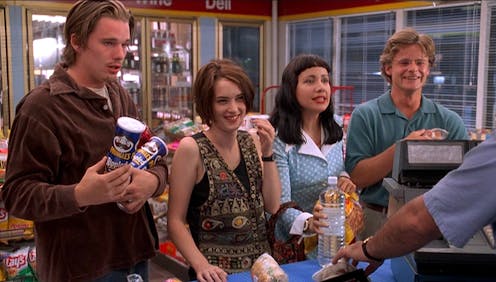
Recording vertical video through a phone, Janis (Auli'i Cravalho) and Damian (Jaquel Spivey) introduce the “cautionary tale” of Cady (Angourie Rice) and her move from being home-schooled in Africa to a North American high school, negotiating “Girlworld” politics and “the plastics” clique to find her true self.

This introduction signifies key changes. Firstly, this is a musical, narrated through the lens of these “art freaks” and puckish best friends. Secondly, much has changed over the past 20 years. In this remake, the style, values and fashion are those of Gen Z – and social media is omnipresent in the teens’ lives.

Mean girls today have a whole new way to be mean.

Shifting landscapes

In 2004, Facebook was limited to Ivy League students. Smartphones were years away. The millennial Mean Girls blocked caller ID to make prank calls “from Planned Parenthood” and used “three-way calling attacks” to create conversational ambushes on landlines.

Most significant was their Burn Book, where they wrote nasty comments about every girl in their year. Regina (Rachel McAdams) used this book to achieve retribution when Cady (Lindsay Lohan) became clique leader. Regina glued her own picture in the book alongside a nasty comment, framed the other plastics, and distributed photocopies to cause a school-wide riot.

Then, bullying was verbal, physical or social. Connectivity was limited and expensive, meaning bullying usually took place in the schoolyard, mall and other physical spaces teens occupied.

The Gen Z Mean Girls exist in an accelerated surveillance culture. School trends go viral, mistakes are meme-ified, and every moment is recorded. Regina (Renee Rapp) is at the centre of this attention economy, crooning that she is a “massive deal” and “the filter you use looks just like me”.

When Cady is invited to join the plastics, her classmates dissect her rise in popularity – and Regina’s downfall – on social media. Research shows using image-based social media, such as TikTok and Instagram, leads to worse mental health outcomes[1].

The Burn Book still exists in the 2024 film. However, this physical device now seems quaint. Today, the internet gives everyone connected voice and power to be a mean girl. Peers hide behind the screen committing what Ms Norbury (Tina Fey, reprising her role from the original film) calls “girl-on-girl crime”.

Classmates conduct social polling on who is “hotter” between Regina and Cady. They discuss Regina’s weight gain publicly online. When the Burn Book is found, its contents are shared via social media, leading to chaos.

Social media has become a major platform for bullying, which can now occur online 24/7. Adolescents have matured in online spaces, leading to worsening mental health[2]. Parents are struggling too. Due to technological changes, 66% of parents in the United States say parenting is harder now[3] than it was 20 years ago.

The Plastics in pink, taking a selfie.
Smartphones and social media have changed the landscape for bullying. Jojo Whilden/Paramount via AP

Social media bullying disproportionately affects girls[4]. The 2024 film shows how this system fails even those at the top – Regina is just as bullied as the girls she picks on. “Influencers” must maintain a carefully curated image and one mistake can go viral online. Judgement is quick, savage and public.

Read more: How to help teen girls’ mental health struggles – 6 research-based strategies for parents, teachers and friends[5]

How to confront bullying in 2024

When Cady is struggling, she turns to her mum (Jenna Fischer), who honestly acknowledges the challenges, saying “you’re learning things now that I don’t know how to teach”.

Rapid technological change means families are often learning new tools together. It is crucial adolescents are not left to navigate this alone.

Whichever generation we identify with, there are strategies we can use to protect our mental health around social media:

  • turn off notifications[6] so you choose when to use the device. Set a time limit for usage each day and stick to it

  • focus on wellbeing[7]. Keep devices out of bedrooms. Ensure breaks are taken from screens. Time spent offline in nature is particularly restorative

  • discuss[8] what is seen online. Be aware of the constructed nature of social content, including filters and image editing. Highlights reels should not be compared to our daily lives

  • reflect on privacy and what you want to share with the world[9]. Even images or text shared in a private channel can be screenshotted or downloaded. Legislation is slow to catch up with technology. For example, teens sharing nude photos with peers can be charged[10] with child pornography distribution in many jurisdictions

  • take feelings seriously[11]. Disconnect as a first strategy, and uninstall platforms that have a negative impact. Gain support from real world friends and family.

Mean Girls shows the dangers of popularity and models ways to maintain agency and self-worth. Recognising her own problematic behaviour, Cady reconstructs her identity with support from friends, gaining recognition for her intellectual ability as a mathlete.

Janis provides a more radical response[12], rejecting socialisation that rewards artificial niceties and breeds duplicity in girls, a system wherein “boys get to fight, we have to share”.

Janis offers another way to deal with online and offline bullies and retain self-worth, encouraging peers to “solemnly swear ‘whatever they say about me I don’t care!’”.

Read more: How parents and teens can reduce the impact of social media on youth well-being[13]

References

  1. ^ mental health outcomes (www.commonsensemedia.org)
  2. ^ worsening mental health (theconversation.com)
  3. ^ 66% of parents in the United States say parenting is harder now (www.pewresearch.org)
  4. ^ disproportionately affects girls (theconversation.com)
  5. ^ How to help teen girls’ mental health struggles – 6 research-based strategies for parents, teachers and friends (theconversation.com)
  6. ^ turn off notifications (www.forbes.com)
  7. ^ focus on wellbeing (theconversation.com)
  8. ^ discuss (www.apa.org)
  9. ^ what you want to share with the world (theconversation.com)
  10. ^ can be charged (www.criminalsolicitorsmelbourne.com.au)
  11. ^ take feelings seriously (childmind.org)
  12. ^ a more radical response (www.youtube.com)
  13. ^ How parents and teens can reduce the impact of social media on youth well-being (theconversation.com)

Read more https://theconversation.com/that-filter-you-use-looks-just-like-me-what-the-new-mean-girls-film-gets-right-about-social-media-221206

Times Magazine

Why Interactive Panels Are Replacing Traditional Whiteboards in Perth

Whiteboards have been part of classrooms and meeting rooms for decades. They’re familiar, flexible...

The Engineering Innovations Transforming the Australian Heavy Transport Fleet

Australia is a massive continent, and its national supply chain relies almost entirely on the road...

Petrol Prices Soar and Rationing Fears Grow — The 10 Cheapest Cars to Run in Australia

Australians are once again confronting a familiar pressure point: the cost of fuel. With petrol pr...

Why Is Professional Porsche Servicing Important for Performance and Longevity?

Owning a Porsche is a symbol of precision engineering, luxury, and high performance. To maintain t...

6 ways your smartwatch is lying to you, according to science

You check your smartwatch after a run. Your fitness score has dropped. You’ve burnt hardly any...

Has the adoption of electric vehicles led to new forms of electricity theft

Why the concern exists Electric vehicles (EVs) like the Tesla Model 3 or Nissan Leaf shift “fue...

The Times Features

In 2006, The Devil Wears Prada Became One of the First …

When The Devil Wears Prada premiered in 2006, it was marketed as a sharp, entertaining adaptation ...

Protecting High-Value Homes Before Sale: A Practical Gu…

Selling a premium home is rarely just about listing and waiting. At the top end of the market, buy...

Eumundi Markets: One of the Sunshine Coast’s most power…

As Queensland prepares for Small Business Month in May, Experience Eumundi is highlighting the cri...

Club Med Expands Exclusive Collection Portfolio with a …

Club Med, the global leader in premium all-inclusive holidays for 75 years, and Central Group Capita...

Cost of living increases worry Farrer residents

COST OF LIVING ‘CRUNCH’ HITS FARRER HARD, THE NATIONALS HEAR During a visit to Albury this week...

What's On: Two Psychics and a Medium – Australian …

HIT LIVE SHOW TWO PSYCHICS AND A MEDIUM EMBARK ON  AUSTRALIAN TOUR — AND NO TWO NIGHTS WILL BE T...

Before vaccines, diphtheria used to kill hundreds each …

The Northern Territory[1] and Western Australia[2] are experiencing outbreaks of an almost-era...

realestate.com.au attracts the buyer for 9 in 10 listed…

New PropTrack data reveals the impact realestate.com.au has on property sales, with the  platfor...

The Hidden Threat Inside Data Centers: Why Fuel Degrada…

Data centers are designed with one overriding objective: uninterrupted operation. To achieve this...