A shocking statistical fact that will change the way you think about the gender pay gap
- Written by: Robert Breunig, Professor of Economics and Director, Tax and Transfer Policy Institute, Crawford School of Public Policy, Australian National University
Domestic violence committed on female partners in heterosexual couples occurs significantly more frequently when the woman earns more than the man — according to our findings about 35% more often.
Our research[1] linking domestic violence to gender income balance is a world first.
We are astounded by the strength of the association.
The following graph tracks the probability of partner violence reported by women against the share of a couple’s income earned by the woman.
Probability of partner violence by % of partner income earned by the woman
 Sources: PSS Murf waves 2006 and 2016[2]
It clearly illustrates a link.
It shows the likelihood of abuse increasing abruptly when a woman’s income is greater than that of her male partner.
While the probability of abuse against women seems to go back down to baseline levels once women earn 80% of income, it’s important to note that our estimates become very imprecise because of the small sample size above 75%.
Our data also sampled for incidence of emotional abuse, finding a marked 20% increase in frequency of reports from females in heterosexual couples in which female earnings were greater than male earnings.
Known but not acknowledged
Previous research has shown that other negative markers – divorce and relationship breakdown levels, unhappiness within relationships, etc – are also higher in relationships with a female earnings leader.
The data we examined, drawn from three waves of the Australian Bureau of Statistics’ Personal Safety Survey[3] (2005, 2012 and 2016) showed the same patterns in abuse levels regardless of participants’ absolute income or education, age or countries of birth.
The frequency of reports of abuse made by males in heterosexual relationships bore no relation to relative income levels.
Read more:
Will the Coalition's approach to gender improve women's lives?[4]
While our research is a world first, other research suggests our findings are understood if not widely acknowledged.
Responding to one global study, 32%[5] of Australian women agreed with the statement: if a woman earns more than her husband, it is almost certain to cause a problem.
Globally the figure is far higher — 51% of women agreed with the statement.
The strength of the norm that the man in a couple earns more than the woman is evidenced in data tracking the share of earnings contributed by the woman.
Few women earn more than the man
This graph, created using 17 years of data from the Household, Income and Labour Dynamics in Australia survey, shows the proportion of couples in each income distribution range.
Proportion of couples with each income distribution
Sources: PSS Murf waves 2006 and 2016[2]
It clearly illustrates a link.
It shows the likelihood of abuse increasing abruptly when a woman’s income is greater than that of her male partner.
While the probability of abuse against women seems to go back down to baseline levels once women earn 80% of income, it’s important to note that our estimates become very imprecise because of the small sample size above 75%.
Our data also sampled for incidence of emotional abuse, finding a marked 20% increase in frequency of reports from females in heterosexual couples in which female earnings were greater than male earnings.
Known but not acknowledged
Previous research has shown that other negative markers – divorce and relationship breakdown levels, unhappiness within relationships, etc – are also higher in relationships with a female earnings leader.
The data we examined, drawn from three waves of the Australian Bureau of Statistics’ Personal Safety Survey[3] (2005, 2012 and 2016) showed the same patterns in abuse levels regardless of participants’ absolute income or education, age or countries of birth.
The frequency of reports of abuse made by males in heterosexual relationships bore no relation to relative income levels.
Read more:
Will the Coalition's approach to gender improve women's lives?[4]
While our research is a world first, other research suggests our findings are understood if not widely acknowledged.
Responding to one global study, 32%[5] of Australian women agreed with the statement: if a woman earns more than her husband, it is almost certain to cause a problem.
Globally the figure is far higher — 51% of women agreed with the statement.
The strength of the norm that the man in a couple earns more than the woman is evidenced in data tracking the share of earnings contributed by the woman.
Few women earn more than the man
This graph, created using 17 years of data from the Household, Income and Labour Dynamics in Australia survey, shows the proportion of couples in each income distribution range.
Proportion of couples with each income distribution
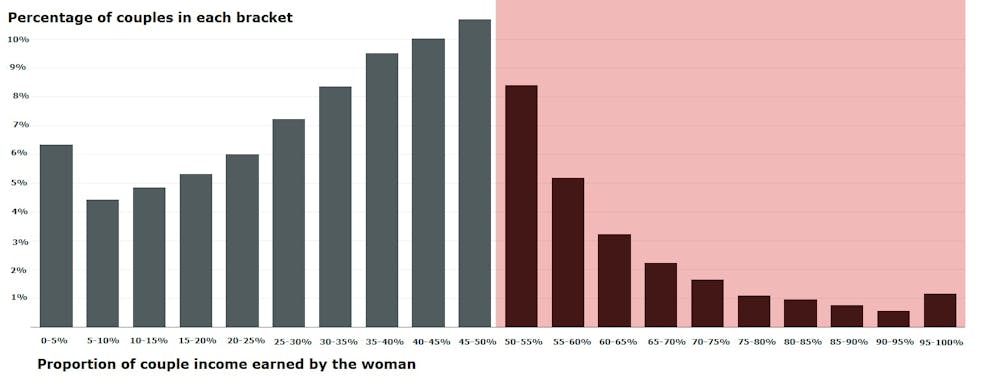 The significant bulge in the number of couples whose female partner earns slightly less than the male partner suggests a gender norm inhibiting women earning more than men.
Combined with the topography of domestic abuse emerging from our study it suggests that what we are seeing reflects reality and is not an artefact of female earnings leaders feeling empowered to report.
Probably not a reporting effect
Further evidence against this being a reporting effect is that the sharp spike in reports of domestic abuse about the 50% cut off occurs irrespective of income or education. It would be an odd kind of reporting issue if it wasn’t affected by income or education but solely by this cut off.
One sobering implication is that we can not assume that domestic violence will simply disappear as women’s labour market prospects improve.
Read more:
Why family violence leave should be paid[6]
Gender norms might not evolve as quickly as women’s advances in earnings and employment.
The norm that creates a bulge of working women earning less than their partners may be a consequence of society’s tacit acknowledgement of this fact.
One hope is that by recognising and highlighting this fact we are contributing one of the missing puzzle pieces in the endeavour to understand and close the gender pay gap.
The significant bulge in the number of couples whose female partner earns slightly less than the male partner suggests a gender norm inhibiting women earning more than men.
Combined with the topography of domestic abuse emerging from our study it suggests that what we are seeing reflects reality and is not an artefact of female earnings leaders feeling empowered to report.
Probably not a reporting effect
Further evidence against this being a reporting effect is that the sharp spike in reports of domestic abuse about the 50% cut off occurs irrespective of income or education. It would be an odd kind of reporting issue if it wasn’t affected by income or education but solely by this cut off.
One sobering implication is that we can not assume that domestic violence will simply disappear as women’s labour market prospects improve.
Read more:
Why family violence leave should be paid[6]
Gender norms might not evolve as quickly as women’s advances in earnings and employment.
The norm that creates a bulge of working women earning less than their partners may be a consequence of society’s tacit acknowledgement of this fact.
One hope is that by recognising and highlighting this fact we are contributing one of the missing puzzle pieces in the endeavour to understand and close the gender pay gap.
References
- ^ research (taxpolicy.crawford.anu.edu.au)
- ^ Sources: PSS Murf waves 2006 and 2016 (taxpolicy.crawford.anu.edu.au)
- ^ Personal Safety Survey (www.abs.gov.au)
- ^ Will the Coalition's approach to gender improve women's lives? (theconversation.com)
- ^ 32% (www.worldvaluessurvey.org)
- ^ Why family violence leave should be paid (theconversation.com)
Authors: Robert Breunig, Professor of Economics and Director, Tax and Transfer Policy Institute, Crawford School of Public Policy, Australian National University