A Rare Arrival: F.P. Journe’s Vagabondage II Finds Its Way to Australia
- Written by: Times Media
There are certain watches that don’t announce themselves loudly. They move quietly, between collectors, through private conversations, occasionally surfacing at auction before disappearing again into long-term ownership. The Vagabondage series by François-Paul Journe has always belonged to that world.
So when a Vagabondage II appears publicly, particularly in a market like Australia, it tends to carry a different kind of weight. Not hype, not spectacle, but recognition. Among those who follow independent watchmaking closely, it’s the sort of piece that prompts a pause.
Its recent availability through SRK Haute Horlogerie is less about retail presence and more about access, something Australian collectors have historically had to look offshore to find.
A Series That Was Never Meant to Be Conventional
The Vagabondage line was never conceived as a traditional collection. In fact, its origins are closer to an experiment than a product launch. The first piece emerged from a unique commission, and that spirit slightly detached from commercial expectations has remained intact ever since.
The earliest iteration introduced the tortue-shaped case and a wandering hours display, referencing historical ways of reading time while avoiding any sense of nostalgia. It didn’t try to fit neatly into the broader catalogue.
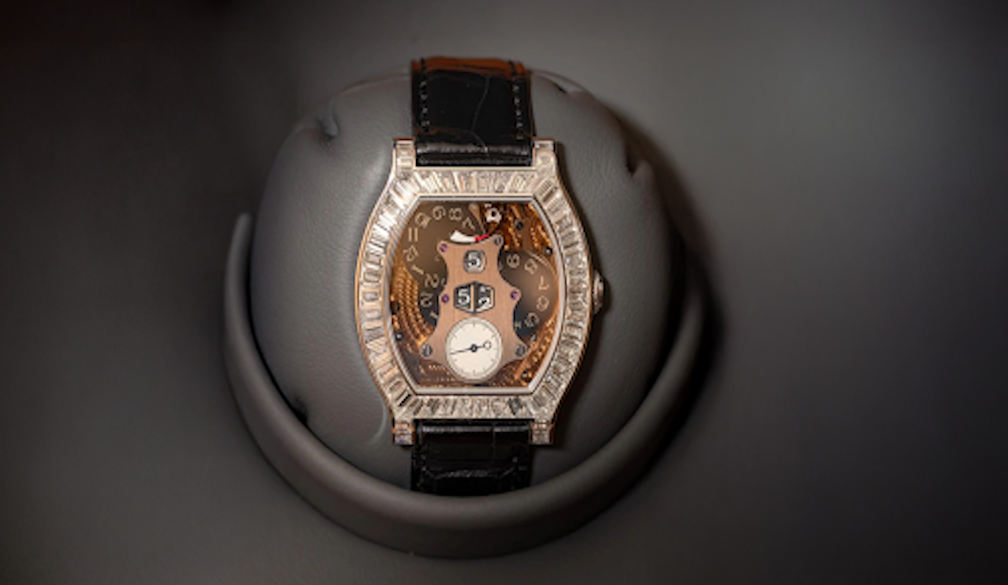
By the time the F.P. Journe Vagabondage II Rose Gold Baguette arrived, the direction had shifted. The wandering hours gave way to a digital jumping display hours and minutes presented through apertures, advancing instantaneously. It was a more assertive concept, mechanically more demanding, and visually more immediate.
The third chapter would go even further, adding digital seconds. But for many collectors, the second remains the most compelling. It strikes a balance the others don’t quite attempt complex, but not excessive; unconventional, yet still wearable in a practical sense.
The Quiet Complexity Behind the Display
At a glance, the Vagabondage II can be misleading. Its display feels almost electronic in its clarity, clean numerals, instantaneous transitions, a sense of precision that appears effortless.
But that effortlessness is exactly the point.
Jumping time displays are inherently demanding. Unlike hands that move continuously, these mechanisms require energy to be stored and released at precise intervals. Managing that energy without compromising accuracy is where the real challenge lies.
Journe’s approach here is characteristically disciplined. The movement regulates power delivery so that each jump, whether of the hour or minute, happens cleanly, without hesitation or disruption. It’s a technical solution that doesn’t draw attention to itself, but once understood, becomes difficult to overlook.
Form That Refuses to Blend In
Then there’s the case.
The tortue shape has always set the Vagabondage apart. It resists easy categorisation neither round nor rectangular, but something more considered. On the wrist, it sits differently too, with a presence that feels deliberate rather than exaggerated.
In the rose gold baguette-set version, that presence shifts again. The addition of precisely cut stones doesn’t overwhelm the design; instead, it follows the case’s geometry, reinforcing its structure. It’s less about ornamentation and more about continuity, an extension of the form rather than an overlay.
It’s also worth noting how rarely such configurations appear. Within an already limited production, these variations occupy an even narrower space.
Rarity Without Noise
Scarcity in watchmaking is often overstated. Limited editions are announced, numbered, and marketed with predictable language.
The Vagabondage series operates differently.
Its rarity is less about declaration and more about reality. These watches were never produced in large numbers, nor were they intended to circulate widely. As a result, they tend to surface infrequently, often through auctions or private sales rather than conventional retail channels.That pattern has shaped how collectors perceive them. There’s no urgency attached, no sense of manufactured demand. Instead, there’s a slower recognition and understanding that when one does appear, it may not do so again for some time.
A Market That’s Looking Beyond the Obvious
Over the past decade, the conversation around high-end watchmaking has shifted. Increasingly, attention has moved toward independent makers whose work prioritises originality over scale.
F.P. Journe sits firmly within that space, though in a way that feels distinct even among peers. His watches are not designed to appeal broadly. They require a certain level of engagement, both technically and aesthetically.
Auction results over the years have reflected this. Not through sudden spikes or speculative swings, but through consistent interest. Pieces like the Vagabondage II tend to attract informed bidders collectors who understand what they’re looking at, and why it matters.
Why This Matters in an Australian Context
For Australian collectors, access has always been the underlying challenge.
The domestic market has matured significantly, with growing demand for rare and investment-grade timepieces. But historically, sourcing something like a Vagabondage II meant navigating international networks, dealers, auctions, and private contacts.
That’s what makes its presence here notable.
Through SRK Haute Horlogerie, a piece that would typically circulate offshore is now visible within the local landscape. It doesn’t change its rarity, but it does change its accessibility at least momentarily.
More broadly, it reflects a shift in the Australian collector base. There’s a growing appetite for watches that sit outside the mainstream, pieces that offer a different kind of value, intellectual, mechanical, and long-term.
A Different Kind of Retail Presence
It would be easy to interpret this as a simple retail listing. But that framing doesn’t quite fit.
What platforms like SRK Haute Horlogerie represent is something closer to curation. The ability to source a watch like this particularly in such a specific configuration suggests a network built around collectors rather than inventory cycles.
In that sense, the watch remains the focal point. The platform simply facilitates its movement, connecting it with a collector who recognises its significance.
Collector’s Note
For many collectors, there comes a point where familiarity loses its appeal. After the expected acquisitions, attention shifts toward pieces that challenge conventional ideas of what a watch should be.
The Vagabondage II often enters the conversation at that stage.
It doesn’t rely on legacy in the traditional sense, nor does it follow established design codes. Its appeal is more personal rooted in how it approaches time, how it wears, how it reveals itself over time.
It’s the kind of watch that tends to stay once acquired.
Closing Reflection
The appearance of a Vagabondage II in Australia won’t redefine the market overnight. It isn’t that kind of watch.
But it does mark a moment small, perhaps, but meaningful. A sign that the boundaries of collecting are shifting, that access is becoming less geographically constrained, and that interest in independent watchmaking continues to deepen.
For François-Paul Journe, the Vagabondage series was never about broad appeal. It was about exploring ideas, pushing against expectations, and creating something that stood apart.
That it has now, briefly, found its way into the Australian spotlight feels entirely consistent with that philosophy quiet, deliberate, and unmistakably distinctive philosophy.