The Hidden Step Most Door Glass Replacements Skip: Getting the Window Drop Right on Frameless Doors
- Written by: Times Media
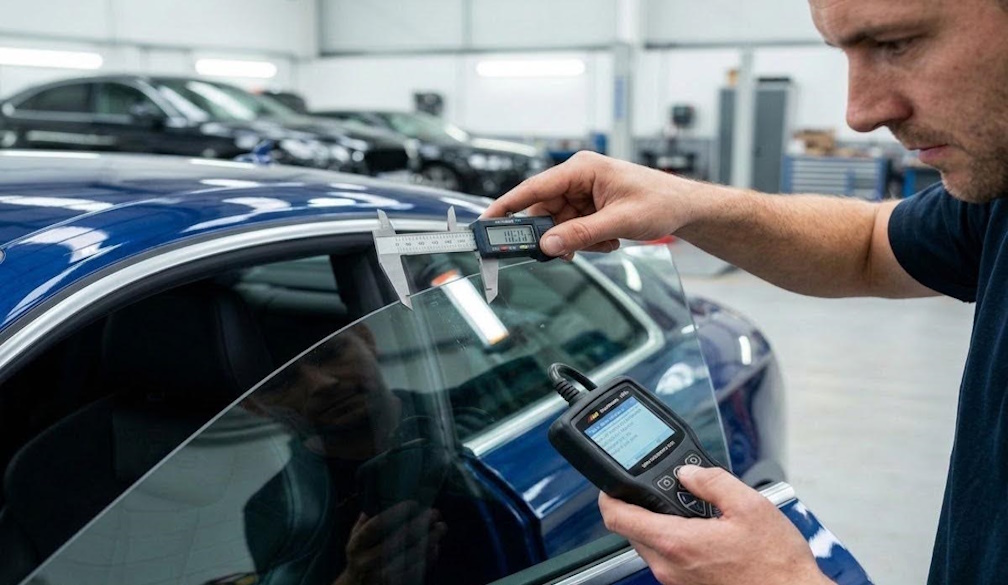
A door glass replacement can look complete at pickup and still be missing a calibration step that only shows up weeks later as wind noise or water tracking into the door card. The glass itself is rarely the problem. What's usually missing is a reset that has nothing to do with the pane and everything to do with how the window moves in the seconds before and after the door opens.
Many vehicles built in the last fifteen years, particularly European models and most coupe or frameless-door body styles, don't simply raise and lower the door glass on command. When the door handle is pulled or the door is opened, the window control module drops the glass a few millimetres first, clearing the weatherstrip before the door swings out. Closing the door reverses the process, and the glass rises back up to seal against the roofline. This is a separate, short-travel cycle from the main up-down window function, tied to the door latch and handle sensors rather than the window switch itself. Disconnecting and reconnecting the regulator or the battery during a glass replacement resets that cycle's timing, or drops it out altogether. The window still moves up and down normally. It simply stops dropping and rising at the correct point relative to the door opening and closing.
That's the part an incomplete job leaves unfinished, and it's genuinely difficult to catch at handover because the effect builds over weeks rather than appearing immediately. If the glass doesn't drop far enough before the door opens, the top edge drags against the seal or the frame edge on every use, gradually wearing through the weatherstrip's sealing lip. If it doesn't rise fully before the door clicks shut, the seal never compresses properly against the glass, and a fit that looked tight in the driveway becomes a whistle at highway speed and, over time, a path for water to track down inside the door.
A related recalibration often gets missed alongside it: the anti-pinch function on power windows, which reverses the glass if it meets resistance while closing. Like the drop-and-rise cycle, anti-pinch calibration can reset whenever the regulator circuit is interrupted, and a window that no longer registers resistance correctly is a safety issue rather than a comfort one. Neither fault is visible by inspecting the glass. Both require the calibration sequence to actually be run rather than assumed to have survived the swap.
Glass specification is the other place shortcuts go unnoticed. Factory door glass on higher trim variants is often a different thickness or carries an acoustic laminate layer specifically to reduce cabin noise, and a visually identical pane without that lamination fits the frame perfectly while quietly changing how the cabin sounds at speed. Tint density matters as well, since replacement glass needs to match both the original factory tint and the legal limits that apply to that window position. None of this is apparent from a photo of the finished job, which is why it's worth confirming what a quote actually includes. A properly executed car door glass replacement covers the drop-cycle and anti-pinch recalibration alongside sourcing glass that matches the original thickness, tint and acoustic spec, rather than treating the fit-check at pickup as the final step.
None of this applies to every vehicle. Framed-door utes, most SUVs and older sedans have no drop-and-rise cycle to recalibrate, since the glass seals against a fixed frame rather than the door itself. The relearn issue also isn't unique to glass replacement: any regulator work or battery disconnection can trigger the same reset, which is worth knowing if an unrelated repair ever seems to introduce a new noise afterwards.
For anyone assessing a recent door glass replacement, a few indicators are worth checking over the following weeks: a new wind noise that builds with speed and wasn't present before, the window sitting slightly proud or recessed compared with the opposite side of the car, dampness or watermarks on the door card or carpet after rain, and a power window that reverses unexpectedly or fails to respond to light resistance the way it previously did. Each of these points back to the calibration step rather than the glass itself, and correcting it is typically a five-minute task for a shop that knows to check for it.