The Times Australia
Google AI
The Times World News

.

Amid global crisis, how can universities be regenerated to serve the common good?

  • Written by Kristen Lyons, Professor Environment and Development Sociology, The University of Queensland
Amid global crisis, how can universities be regenerated to serve the common good?

Universities are among the many institutions that sustain settler colonialism in Australia. The public university system was, and continues, to be part of the state’s investment in its own future.

Universities emerged in Australia during the mid-19th and early 20th centuries against a backdrop of frontier violence and dispossession of First Nations’ lands, labour and relationships[1]. While nature was privatised and commodified, universities grew in scale and influence. Knowledge hierarchies[2] that perpetuate racial, class and gender divides were normalised.

Read more: Five shifts to decolonise ecological science – or any field of knowledge[3]

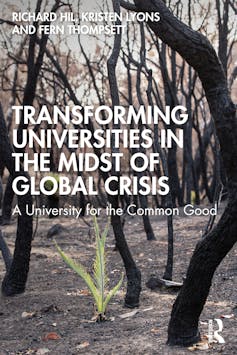
Cover of Transforming Universities in the Midst of Global Crisis, a book by the authors
Routledge[4] Our new book, Transforming Universities in the Midst of Global Crisis: A University for the Common Good[5], scrutinises the role of universities today. We argue these institutions, and indeed the entire higher education sector, must be considered as not only in crisis – though they clearly are – but also as drivers of crisis[6]. Universities have become fully integrated into the neoliberal economy. They fixate on vocational “job-ready” curriculums and commercial research agendas. They enable industries built on extracting natural resources and thereby support endless economic growth. The problems arising from this system are destructive and life-threatening[7]. Climate chaos, biodiversity destruction, the COVID-19 pandemic, the democracy recession and deepening socio-economic inequalities[8] have reshaped our very ways of relating, being and knowing. Transforming universities therefore demands we seek out ideas, practices and values beyond the university’s walls. Only then will universities be capable of responding to interconnected ecological, health and social challenges. Drawing from case studies and examples around the world, we show how this transformation is possible - and, indeed, already under way. Read more: After coronavirus, universities must collaborate with communities to support social transition[9] Crisis as a catalyst for change In the 21st century, multiple mega-crises have ravaged ecological systems, human lives and livelihoods. A small but powerful lobby of political interests continues to deny, downplay or divert[10] attention from such problems. Yet turning to face these challenges may shed light on solutions. US scholar Lauren Berlant suggested[11]: At some crisis times like this one politics is defined by a collectively held sense that a glitch has appeared in the reproduction of life […] A glitch is also the revelation of an infrastructural failure.“ But glitches can – and must – provide the impetus to bring alternative worlds into being. For universities, the challenge now is to situate human relations and responsibilities in the web of life[12] on Earth. The Ecoversities Alliance[13], for example, is working for a change of ecological consciousness. This involves a shift away from the pursuit of private interest and towards ecological integrity and the common good. The goal is to orient universities towards "service of our diverse ecologies, cultures, economies, spiritualities and life within our planetary home”. Another challenge is to decolonise universities. The Dechinta Bush University[14] in the Northwest Territories in Canada provides an exemplar. The university has embraced Indigenous land-based practices and values. In this context, Indigenous pedagogies and practices refuse the colonial enclosures of traditional “education-based” institutions. In countless other ways, in Australia and elsewhere, Indigenous scholars[15], educators[16] and activists are leading decolonising, anti-racist and ecological governance[17] agendas. Read more: How a university can embed Indigenous knowledge into the curriculum and why it matters[18] What will it take to transform universities? Universities, of course, cannot be transformed in isolation from the wider world. Change must engage with the values, practices and leadership of progressive movements. Examples include Black Lives Matter[19], #MeToo[20] and movements for Indigenous sovereignty[21] and treaty[22]. Our book documents the possibilities for radically transforming the political and economic structures that universities are built on and continue to uphold. The change agenda needs to be bold, not piecemeal. We showcase activities and interventions that move beyond superficial reformism to more radical possibilities[23] for change. Among many other things, we call for: more democratic university governance a return to the idea of the public university (as set out in state and territory legislation) decoupling from market-oriented extractivist ideas of growth resistance to “job-ready” graduate tropes genuine and inclusive communities of learning centring Indigenous rights and knowledges in curriculums and research agendas fostering cultures of appreciation, generosity and collaboration as opposed to competition, individualism and hierarchy. Read more: Honouring Te Tiriti means ‘getting into the stream together’ — so this vice-chancellor has become a student again[24] Working for a just and resilient future These transformations are urgent if universities are to be relevant to meeting the challenges of the 21st century. A university for the common good could enable human society to connect with more-than-human communities and operate within the limits of nature. By ensuring accountability to all communities, human and more-than-human, such a university could build more sustainable and just worlds. Vanessa de Oliveira Andreotti and colleagues[25] from the Gesturing Towards Decolonial Futures[26] collective assert that only through the decay of the modern university will regeneration be possible. If so, the challenge for those committed to the future of the university is to ensure that, through its dwindling, a new regenerative approach – within and beyond its walls – flourishes. References^ First Nations’ lands, labour and relationships (www.researchgate.net)^ Knowledge hierarchies (publishing.monash.edu)^ Five shifts to decolonise ecological science – or any field of knowledge (theconversation.com)^ Routledge (www.routledge.com)^ Transforming Universities in the Midst of Global Crisis: A University for the Common Good (www.routledge.com)^ drivers of crisis (www.upress.umn.edu)^ destructive and life-threatening (www.democracynow.org)^ deepening socio-economic inequalities (www.theguardian.com)^ After coronavirus, universities must collaborate with communities to support social transition (theconversation.com)^ deny, downplay or divert (www.theguardian.com)^ suggested (journals.sagepub.com)^ web of life (www.tandfonline.com)^ Ecoversities Alliance (ecoversities.org)^ Dechinta Bush University (www.mytruenorthnow.com)^ Indigenous scholars (www.scribd.com)^ educators (books.google.com.au)^ ecological governance (www.onlineopinion.com.au)^ How a university can embed Indigenous knowledge into the curriculum and why it matters (theconversation.com)^ Black Lives Matter (blacklivesmatter.com)^ #MeToo (metoomvmt.org)^ sovereignty (books.google.com.au)^ treaty (www.aspistrategist.org.au)^ radical possibilities (www.tandfonline.com)^ Honouring Te Tiriti means ‘getting into the stream together’ — so this vice-chancellor has become a student again (theconversation.com)^ Vanessa de Oliveira Andreotti and colleagues (representing-education.gertrudecotter.info)^ Gesturing Towards Decolonial Futures (decolonialfutures.net)

Read more https://theconversation.com/amid-global-crisis-how-can-universities-be-regenerated-to-serve-the-common-good-172495

Times Magazine

Narwal Freo Z Ultra Robotic Vacuum and Mop Cleaner

Rating: ★★★★☆ (4.4/5)Category: Premium Robot Vacuum & Mop ComboBest for: Busy households, ha...

Shark launches SteamSpot - the shortcut for everyday floor mess

Shark introduces the Shark SteamSpot Steam Mop, a lightweight steam mop designed to make everyda...

Game Together, Stay Together: Logitech G Reveals Gaming Couples Enjoy Higher Relationship Satisfaction

With Valentine’s Day right around the corner, many lovebirds across Australia are planning for the m...

AI threatens to eat business software – and it could change the way we work

In recent weeks, a range of large “software-as-a-service” companies, including Salesforce[1], Se...

Worried AI means you won’t get a job when you graduate? Here’s what the research says

The head of the International Monetary Fund, Kristalina Georgieva, has warned[1] young people ...

How Managed IT Support Improves Security, Uptime, And Productivity

Managed IT support is a comprehensive, subscription model approach to running and protecting your ...

The Times Features

Small, realistic increases in physical activity shown to significantly reduce risk of early death

Just Five Minutes More a Day Could Prevent Thousands of Deaths, Landmark Study Finds Small, rea...

WITH ONE GLOBAL RESORTS FEATURING ON SCREEN THIS SEASON

As Married At First Sight returns to Australian screens in 2026, viewers are once again getting a ...

Migraine is more than just a headache. A neurologist explains the 4 stages

A migraine attack[1] is not just a “bad headache”. Migraine is a debilitating neurological co...

Marketers: Forget the Black Box. If You Aren't Moving the Needle, What Are You Doing?

Two years ago, I entered the digital marketing space with the mindset of an engineering student ...

Extreme weather growing threat to Australian businesses in storm and fire season

  Australian small businesses are being hit harder than ever by costly disruptions...

Join Macca’s in supporting Clean Up Australia Day

McDonald’s Australia is once again rolling up its sleeves for Clean Up Australia Day, marking 36...

IFTAR Turns Up The Heat With The Return of Ramadan Nights From 18 February

Iftar returns to IFTAR, with the Western Sydney favourite opening after dark for Ramadan  IFTA...

What causes depression? What we know, don’t know and suspect

Depression is a complex and deeply personal experience. While almost everyone has periods of s...

5 Cool Ways to Transform Your Interior in 2026

We are at the end of the great Australian summer, and this is the perfect time to start thinking a...