The 'city' is becoming increasingly digital, forcing us to rethink its role in life and work
- Written by: Alexia Maddox, Research Fellow, Blockchain Innovation Hub, RMIT, RMIT University
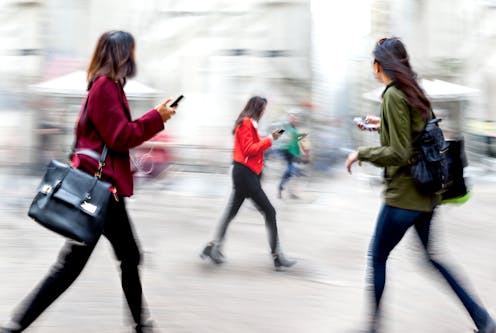
The role of the city is changing. To find out how, we surveyed more than 2,000 Victorians living in Melbourne, its suburbs and regional centres in April 2022.
The survey is the first of its kind in Australia and documents a pivotal point in Melbourne of social and economic reopening after long and stringent COVID lockdowns. The findings are being released today[1] in our Digital Infrastructures report as a part of the Digital CBD project[2].
At the threshold of a “new normal”, we found the long lockdowns[3] to contain the spread of the virus, and the rapid adoption of digital technologies, have changed the way we engage with the city. It’s now seen as less a place of work and more of a place for socialising, shopping and services.
What people told us is that at the time of reopening in Melbourne, they were getting into the city about once a month on average. This included people living in the suburbs and regional centres. People who went into the city for work did so for an average of only nine hours a week.
It’s not surprising they were visiting the city centre much less often but, still, it raises the question of what we want to use the city for[4]. That was the subject of a long and complex debate[5] even before the pandemic.
We surveyed a representative sample of 2,064 people. This means we can be confident that what they told us broadly represents experiences across the population.
RMIT researchers interviewed people about how they feel about Melbourne and the rise of a digital city.Read more: Liveable cities: who decides what that means and how we achieve it?[6]
What is the role of the city in the wake of the pandemic?
Work remains the main reason[7] for people to engage with the city. Our survey respondents in the workforce did so for an average of nine hours a week.
When we look at the work-from-home data we gathered, one in seven employed people work from home completely, and a third practice hybrid work arrangements in Victoria. We found that on average people will work from home two days a week. These averages are taken from people who live and work full-time and part-time across the regions and suburbs, not just in the inner city. Most employed people valued and wanted to continue to have this choice of whether to work from home or in the office.
So, Melbourne city can’t really be thought of as the place where workers go – that is, the office hive. What people told us makes it seem like a lifestyle space. Indeed, what they felt was important in Melbourne was the hospitality scene, essential services (such as medical appointments), and the cultural and creative life, including education, sport and shopping.
Read more: Few Australians have the right to work from home, even after COVID. Here's how that could change[8]
The suburbs as ‘cities’
But many could easily find those activities in their suburbs[9]. This means getting to the city is much less important for them.
Those living in the regions had more trouble remembering when they last visited the city, which suggests it is not essential to their everyday lives.
Despite these perceptions of the shifting centrality of the city in people’s daily lives, residents felt they were spending about the same amount of time in the city as before the pandemic. This observation needs to be treated with caution because a quarter of Melbourne residents in our survey were spending much less time in the city than before the pandemic.
Are people ready for a digital city?
These findings suggest we need to ask whether a city can depend on its reputation for lifestyle to hold its position in a global economy, or as a political centre and trade gateway. As digital technologies have been rapidly adopted during the pandemic, we think it is more important to consider how we can position Melbourne as a digital city of the future.
A digital city refers to the array of connected devices and infrastructures that complement the city’s business, cultural and social life. Digital activities range from personal devices such as smartphones to initiatives like the digital art gallery[10].
In our report[11] on the new infrastructure demands for Melbourne, we see the city as an eclectic hub that supports entrepreneurial, creative, cultural, learning and digital endeavours that interweave the regions and connects to the global context.
Read more: Tech diplomacy: cities drive a new era of digital policy and innovation[12]
Digital inclusion is vital
But for city residents to know how to engage with and benefit from a digital city, they need to have the skills and access to technology. Melbourne residents also told us about their digital abilities. Like the findings from the Australian Digital Inclusion Index[13], we found Melburnians have high digital abilities, but not all are ready for the digital city of the future.
Digital skill-building is essential. We also need to ensure technologies are accessible and affordable and that internet access is reliable so no one is left behind[14].
The pandemic has transformed the city. This is an opportunity for some more imaginative thinking.
Our report highlights the investments we need to make to create a more inclusive city. We now need to think about what is needed, materially and socially, for a digital city to foster wellbeing for every individual and across society.
References
- ^ being released today (www.rmit.edu.au)
- ^ Digital CBD project (www.rmit.edu.au)
- ^ long lockdowns (theconversation.com)
- ^ what we want to use the city for (eurocities.eu)
- ^ long and complex debate (theconversation.com)
- ^ Liveable cities: who decides what that means and how we achieve it? (theconversation.com)
- ^ Work remains the main reason (theconversation.com)
- ^ Few Australians have the right to work from home, even after COVID. Here's how that could change (theconversation.com)
- ^ find those activities in their suburbs (www.theage.com.au)
- ^ digital art gallery (www.theurbanlist.com)
- ^ our report (www.rmit.edu.au)
- ^ Tech diplomacy: cities drive a new era of digital policy and innovation (theconversation.com)
- ^ Australian Digital Inclusion Index (www.digitalinclusionindex.org.au)
- ^ no one is left behind (www.digitalinclusionindex.org.au)