How First Nations fashion design can rewrite painful memories and be a powerful method of healing
- Written by: Treena Clark, Chancellor’s Postdoctoral Indigenous Research Fellow, Faculty of Design, Architecture and Building, University of Technology Sydney
Aboriginal and Torres Strait Islander readers are advised that this article contains names, images and stories of deceased people.
Around the world, fashion researchers, designers and artists are exploring the links between clothing, adornment and wellbeing.
“Enclothed cognition[1]” considers the psychology of clothing, and designers are exploring how to create garments[2] to heal the wearer.
First Nations people understand the power of connection to cultural clothing and adornment. Items like possum and kangaroo skin cloaks can contribute to healing[3] and cultural practice.
But it’s not only traditional clothing that can lead to healing. In Australia, there is a rise of designers and artists creating and fashioning painful Protectionist-era[4] clothing on the runway and in the galleries.
By recreating clothing tied to painful and traumatic memories and histories, these designers and artists hope to share these horrific policies, rewrite the meaning behind them, and move forward in healing.
A history of missions, reserves and trauma
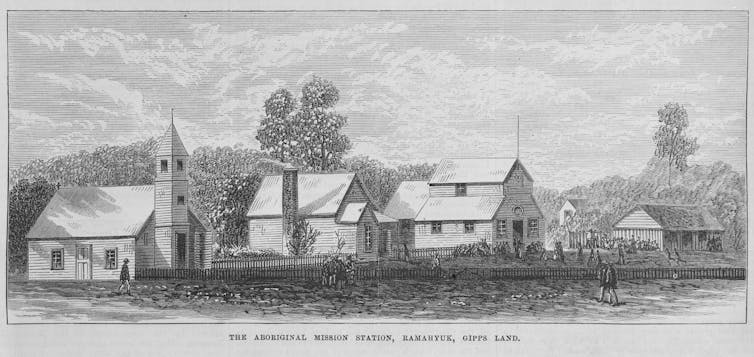
First Nations peoples living in controlled reserves, missions and stations were forced to wear plain clothing and expected to keep them well-maintained and clean[5]. Often, garments were forms of payment and punishment.
In some institutions, First Nations people generated clothing and adornment for interstate and international exhibitions and tourist trades[6].
These regimes and power through clothing[7] significantly impacted those living there, including their cultural practice, identity and wellbeing.
There are two national days[9] to pause, acknowledge and remember the Stolen Generation and their families and communities – National Sorry Day on May 26 and the Anniversary of the National Apology to the Stolen Generations on February 13.
Healing and wellbeing involve a holistic approach, and art contributes to this[10].
Using clothing as art or designing garments with a transformative and positive spin can benefit members of the Stolen Generation and their families.
Healing through fashion design
The Queensland Yarrabah community has been experimenting with fashion to tell Yarrabah Mission stories.
The 2019 Cairns Indigenous Art Fair invited the Djunngaal Yarrabah Elders Group[11] to work on a collection for the Buwal-Barra fashion show. The collection, named ByDaBell, represents the significance of the bell at the Yarrabah Mission, which strictly controlled their day.
Yarrabah Elders recreated three significant dresses[12] worn in the mission: an everyday casual dress, a church formal dress and a punishment potato sack dress. In doing so, the Elders told a powerful story about their mission experiences and how clothing was used to punish or control.
For the Yarrabah community and many First Nations people, truth-telling[13] is a form of healing and reminder of resilience.
Healing through truth-telling was also seen weaved within a commissioned wedding dress[14] made for the 2020 Queensland Museum exhibition I Do! Wedding Stories from Queensland.
As a collaborative effort by fashion designer and artist Simone Arnol (Gunggandji), artist and curator Bernard Singleton (Umpila, Djabugay/Yirrgay) and Djunngaal Yarrabah Elders, the garment told stories about mission experiences and the colonial wedding practices within it.
Based on mission-style wedding dresses, the gown featured[15] a five-metre-long circle train embedded with a powerful image of a mission imprisonment. The stained lining from traditional materials represented the suppression of First Nations culture.

Healing through art garments
Artist Yhonnie Scarce (Kokatha/Nukunu) created a piece about the experiences of her grandmother Fanny and great-great-grandmother Florey as domestic servants in the early 1900s[18].
The work features two linen aprons, depicting those worn by Flora and Fanny, and 16 hand-blown glass bush plums placed inside and poking through the pockets. Their names were also carefully hand stitched onto each apron.
The piece represents[19] the strength of Flora and Fanny in their roles as matriarchs caring for family and holding onto their cultural identity.
Shellworked Slippers[20] by Esme Timbery (Bidjigal) contains 200 pairs of tiny, adorned shoes to represent the children of the Stolen Generation and the shell craft practice[21] of Aboriginal women at La Perouse, Sydney.
Made from fabric and encrusted with glitter and shells of various sizes, colours and designs, the slippers speak to the experiences of the children who were forcibly removed and the strength and resilience of First Nations families and communities.
While not a uniform of children who were removed and placed in institutions, the large quantity of small and empty shoes reminds the viewer of the suffering and trauma experienced under the Protectionist policies.
Sharing stories, remembering history
First Nations fashion designers and artists are transforming Protectionist-era fashions on the runway and in exhibitions. In doing this, they aim to speak back to racist and colonial policies and heal.
We need to keep sharing these stories about the true history of this country and how garments repressed and controlled First Nations people.
The movement toward healing painful memories and intergenerational trauma through garments positively contributes to First Nations people’s wellbeing.
First Nations peoples are resistant and, through clothing, will continue to explore and celebrate culture and identity.
References
- ^ Enclothed cognition (psycnet.apa.org)
- ^ create garments (www.dezeen.com)
- ^ skin cloaks can contribute to healing (www.abc.net.au)
- ^ Protectionist-era (www.nma.gov.au)
- ^ well-maintained and clean (www.academia.edu)
- ^ interstate and international exhibitions and tourist trades (theconversation.com)
- ^ regimes and power through clothing (books.google.com.au)
- ^ State Library Victoria (find.slv.vic.gov.au)
- ^ two national days (healingfoundation.org.au)
- ^ and art contributes to this (www.taylorfrancis.com)
- ^ Djunngaal Yarrabah Elders Group (www.sbs.com.au)
- ^ three significant dresses (www.sbs.com.au)
- ^ truth-telling (www.reconciliation.org.au)
- ^ wedding dress (nit.com.au)
- ^ gown featured (www.facebook.com)
- ^ Queensland Museum (collections.qm.qld.gov.au)
- ^ CC BY-NC-ND (creativecommons.org)
- ^ domestic servants in the early 1900s (artguide.com.au)
- ^ piece represents (researchnow-admin.flinders.edu.au)
- ^ Shellworked Slippers (www.mca.com.au)
- ^ shell craft practice (www.nma.gov.au)