Families Australia Calls for National Action: 44,000 Children in Care as Australia Faces Growing Foster Carer Shortage
- Written by: Times Media
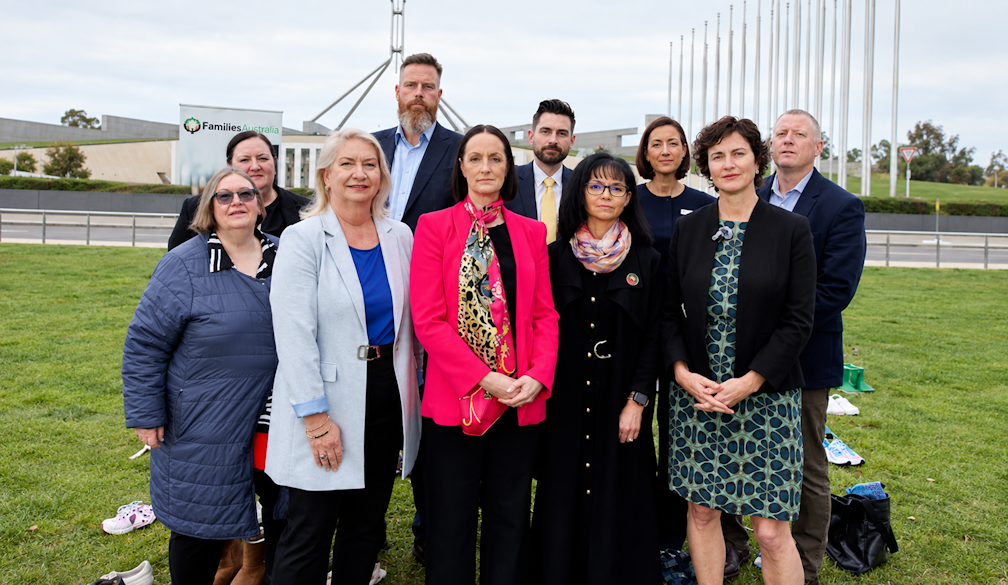
A national coalition of child and family organisations, carers and advocates brought 440 pairs of children’s shoes to Parliament House today, calling for practical national reforms to strengthen foster and kinship care and ensure children can access stable, supported family-based care.
Each pair of shoes represents approximately 100 of the more than 44,000 children and young people living in out-of-home care across Australia.
The number of children entering care remains steady, while the number of new and active foster carers has declined by 21 per cent since 2017, increasing the urgency of growing and sustaining Australia’s community of foster and kinship carers.
The sector warns that without coordinated national action, more children who cannot safely live at home will be left without access to stable, family-based care, placing greater pressure on already stretched carers and increasing reliance on residential care.
Call for practical national reforms
Families Australia and the National Foster Care Sustainability Group (NFCSG) are calling for practical reforms including a portable Passport to Care, better access to health and therapeutic services, reduced financial pressure on carers, and fairer workplace leave arrangements for foster and kinship carers.
Families Australia CEO Suzanne Greenwood said Australia is facing a national crisis in foster and kinship care, with 44,000 children and young people in out-of-home care and the number of foster carers continuing to decline.
“This is a crisis hiding in plain sight. Thousands of children who have experienced abuse, neglect or family violence are relying on a family-based care system that is under serious and growing pressure,” Ms Greenwood said.
“Family-based care is the best option for children who cannot safely live with their families, but foster and kinship carers are being asked to carry enormous financial, emotional and administrative burdens without the practical support they need.”
“Children in care often have complex health, developmental and therapeutic needs. Too many are missing out on timely support because systems are fragmented, difficult to navigate and inconsistent across jurisdictions.”
Ms Greenwood said the National Foster Care Sustainability Group had put forward practical reforms that could help stabilise the foster and kinship care system and deliver better outcomes for children.
“We are calling for a portable Passport to Care so children can access the services and supports they are entitled to wherever they live, and as they move through care, reunification or transition to adulthood,” Ms Greenwood said.
“We also need better access to health, dental, disability and therapeutic supports; action to reduce the financial and tax uncertainty facing carers; and fair workplace leave arrangements so foster and kinship carers can balance caring responsibilities with paid employment.”
“If we want more Australians to open their homes to children who need safety, stability and healing, we have to remove the barriers that make caring harder than it needs to be.”
“These are sensible, achievable reforms. They would ease pressure on carers, help recruit and retain more families, reduce the risk of children being pushed into higher-cost residential care, and give children in care a better chance to be healthy, well and thriving.”
NFCSG Chair Dr Lisa J. Griffiths said Australia’s foster and kinship care system is under increasing pressure, with fewer carers available and more children at risk of being pushed into higher-cost residential care settings.
“This is not a challenge any one jurisdiction can solve alone. Governments have an opportunity to work together on practical, achievable reforms that would make an immediate difference for children in care and the families who support them,” Dr Griffiths said.
“The recent Australian Institute of Family Studies review makes clear what carers have been telling us for years: caring for a child in out-of-home care costs significantly more than current allowances recognise, and carers are being forced to navigate complex and inconsistent systems to access the support children need.”
The reality of foster caring
Foster carer Kelly Jebb is one of a dwindling number of Australians willing and able to be a foster carer. Over the years Kelly has opened her home to children who arrived with almost nothing. No clothes that fit, no medical history, sometimes no idea when they'd last seen a dentist. What they have, she says, is trauma, and a carer's job is to somehow build a stable life around it.
"People think fostering is just love and a spare bedroom," Kelly said. "It's so much more than that. It's chasing specialists, it's organising appointments, juggling case workers, schools, doctors and therapists, it's filling out forms at 11pm because that's the only time you get a spare minute. You're trying to just be a normal, safe adult and give a child stability, but the system around you feels like anything but stable."
“Foster and kinship carers are not asking for recognition alone. They are asking for practical support so they can give children safety, stability and the help they need to recover and thrive,” Ms Jebb said.
“I know the pressures carers face are real, immediate and growing, from the cost of caring to the difficulty of accessing health, therapeutic and specialist supports for children with complex needs.”
“When those supports are delayed, inconsistent or hard to access, children miss out and carers are pushed to breaking point. That is why national action matters.”
The pressure on Australia’s foster carers
Carers like Kelly often find themselves out of pocket, chasing reimbursements, and navigating rules that change depending on which state they live in, or which state a child came from. "If a child moves, their support can basically evaporate," Kelly said. "Their therapy, their medical file, their routine, it doesn't travel with them. So, you start again. Imagine trying to heal from trauma while also starting from scratch every time your address changes."
Dr Griffiths said Kelly's experience was echoed by carers right across the country.
"What Kelly describes - the endless admin, the postcode lottery, the exhaustion of holding a broken system together with good intentions - is what we hear from carers everywhere."
"We know caring for a child in out-of-home care costs carers significantly more than the current allowances recognise, and the system is too complex and inconsistent for families to navigate on top of everything else they're carrying. These are fixable problems. If we want to keep carers like Kelly, and attract new ones, we have to remove the barriers that make caring harder than it needs to be."
Despite the frustrations, Kelly says she has no plans to stop.
"You see a kid go from eating like they don't know when they'll eat again to sharing food and laughing at the dinner table, and you remember why you do this," she said. "But I think about the carers who've walked away, and the kids waiting for a home who might not get one. That's what keeps me up at night."
"Forty-four thousand isn't just a statistic. It's forty-four thousand actual kids, in actual bedrooms, wondering if this is the place they get to stay," she said. "We need more people willing to open their homes. But we also need to stop making it so hard for the ones who already have."