Digital Earth Session at 2025 WSTDF advances SDGs
BEIJING, CHINA - Media OutReach Newswire - 11 November 2025 - The Thematic Session on Digital Earth Supporting Sustainable Development convened during the 2025 World Science and Technology Development Forum (WSTDF) in Beijing on Tuesday, bringing together 70 leading figures and representatives from research institutes and universities of 19 countries and relevant UN agencies and international organizations to tackle the problems along niche opportunities brought by emerging science and technology trends, with consensus on the Digital Earth Initiative for the Sustainable Development Goals.
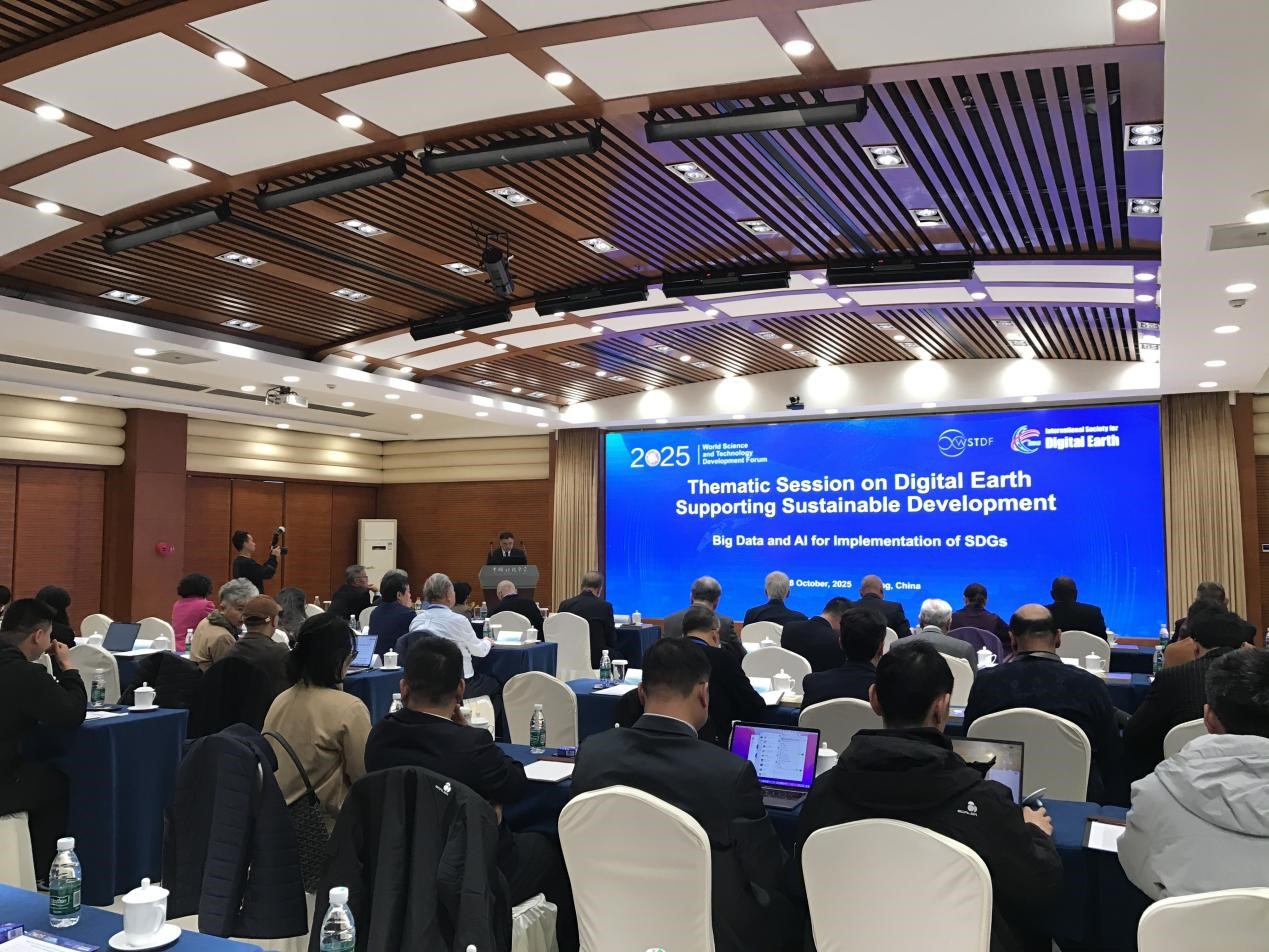
Photo: Participants attend the Thematic Session on Digital Earth Supporting Sustainable Development at the China Hall of Science and Technology in Beijing on October 28, 2025.
Organized by the International Society for Digital Earth (ISDE) with support of the China Association for Science and Technology (CAST), the session, themed "Big Data and AI for Implementation of SDGs," focused on expanding international collaboration and exploring durable mechanisms to better harness Digital Earth technologies for long-term impact on the Sustainable Development Goals (SDGs).
In the opening remarks, Richard Simpson, President of ISDE, described Digital Earth as "a living, adaptive architecture for planetary sense-making and coordinated action," and stressed a dedicated framework within this architecture focuses on SDG reporting, explicitly highlighting climate action (SDG 13).
The keynote section featured several speakers, including Guo Huadong, Academician of the Chinese Academy of Sciences (CAS), Director General of the International Research Center of Big Data for Sustainable Development Goals (CBAS), and Honorary President of ISDE, who highlighted big data's vital role in supporting the UN Sustainable Development Goals. He discussed CBAS's achievements in building open-data platforms, AI-driven monitoring tools, and case studies on food security, climate action, and ecosystem protection, stressing the need to connect scientific data with global governance in order to develop practical solutions that advance sustainable development.
Beyond these achievements, Guo specifically drew attention to the Global-Scale Sustainable Development Scientific Monitoring Report (2025), released just the previous day at the 2025 WSTDF opening ceremony. The report recapitulates a decade of technological breakthroughs that have overcome traditional data limitations and generated comparable monitoring results through big Earth data.
In line with these efforts, the Digital Sustainable Development Goals Programme (DSP)—initiated by CBAS and approved by UNESCO—has secured support from 63 institutions across 32 countries and regions, and will remain instrumental in shaping the post-2030 vision.
Hiromichi Fukui, Former Vice President of the Chubu University in Japan, presented how Digital Earth technology, particularly the Land Cover Breakthrough (LCB) Project, advances sustainability goals. The LCB Project uses AI and satellite data to improve land cover mapping, reducing costs and accelerating progress toward the global 30×30 conservation goal. He emphasized that "we need a world of collaboration" to achieve these objectives.
Other keynote speakers explored integrative frameworks for spatial data, remote sensing, and socioeconomic analysis to support informed decision-making and international cooperation.
Chaired by Li Songnian, Chair of the Academic Network of UN-GGIM, the panel discussion featured representatives from Asia, Africa, Europe, and the Pacific. Discussions examined innovative uses of Digital Earth technologies and principles for responsible geospatial stewardship to advance SDGs, and provided concrete evidence of how AI and big data are transforming SDGs through more robust data infrastructures. Panelists stressed that inclusivity and shared access to digital resources are essential to ensure "no one is left behind" in the world's digital transformation.
The session culminated in the launch of the Digital Earth Initiative for the Sustainable Development Goals, a collaborative framework promoting shared data infrastructures, open science, and ethical applications of AI. Participants agreed that progress toward sustainability rests not only on advanced technology but on stronger international partnerships, an idea echoed throughout the WSTDF's broader agenda of shared innovation and global cooperation.
The Thematic Session on Digital Earth Supporting Sustainable Development, one of ten parallel sessions at the 2025 WSTDF, is closely aligned with the forum's overarching theme, "AI for Science and Development (AI4SD)," showcasing concrete digital solutions in the geospatial domain.
The WSTDF, a flagship sci-tech event launched by CAST in 2019, welcomed around 800 delegates from government, academia, education, and industry this year.
The issuer is solely responsible for the content of this announcement.