Research shows giraffes can use statistical reasoning. They're the first animal with a relatively small brain known to do this
- Written by: Scarlett Howard, Lecturer, School of Biological Sciences, Monash University

Humans make decisions using statistical information every day. Imagine you’re selecting a packet of jellybeans. If you prefer red jellybeans, you will probably try to find a packet that shows the most red (and less of the dreaded black ones) through the small window.
Since you can’t see all the jellybeans at once, you’re using statistical reasoning to make an informed decision. Even infants[1] have this capability.
And as it turns out, humans aren’t alone in using statistical inferences to make decisions. Great apes[2], long-tailed macaques[3] and keas[4] have all been shown to use the relative frequencies of items to predict sampling events.
Now a new study has added giraffes to this list. The research, published today[5] in Scientific Reports, shows giraffes can use statistical inferences to increase their likelihood of receiving carrot slices rather than zucchini – much like a human picking jellybeans.

Brain size and statistical skills
Until now, primates and birds were the only animals to show evidence of statistical reasoning. Both are considered to have large brains relative to body size, which is often linked with higher intelligence[7].
Researchers at the University of Barcelona, University of Leipzig, and Max Planck Institute for Evolutionary Anthropology wanted to test whether an animal with a small brain relative to its body size could perform statistical reasoning.
Giraffes were an ideal choice. They have already demonstrated an ability to perform quantity discrimination[8] (being able to tell a larger amount of items from a smaller amount), and their social systems[9] and dietary breadth[10] have been linked with the emergence of complex cognition.
Read more: Polly knows probability: this parrot can predict the chances of something happening[11]
How does a giraffe demonstrate statistical reasoning?
As it turns out, giraffes love carrots but have only a lukewarm appreciation for zucchinis, making these foods ideal to use in a statistical reasoning task.
Working with four giraffes, the researchers placed different proportions of carrot and zucchini slices into transparent containers to test if the giraffes could predict a higher likelihood of receiving a carrot in three tests of different treat quantities.
Each test consisted of 20 trials in which a researcher selected a piece of food from each container without showing the giraffe. The giraffe then touched the hand it wanted to eat from, using only the information it had from the containers.
The giraffes were reliably able to select the correct container in the trials of the first test, wherein the correct choice had both a higher quantity of carrots and lower quantity of zucchini slices.
In the second test, the quantity of carrots was the same in both containers, but the correct choice had fewer zucchini slices. Again, the giraffes were able to select correctly.
In the third test, the quantity of zucchini slices remained the same, but the correct container had a larger quantity of carrots. Yet again the giraffes chose correctly.
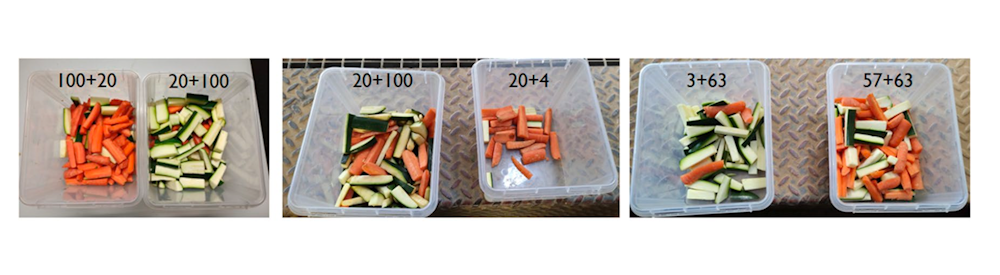 Each test of the experiment used different stimuli. Left to right: test 1, test 2 and test 3.
Alvaro L. Caicoya et al/Scientific Reports
Each test of the experiment used different stimuli. Left to right: test 1, test 2 and test 3.
Alvaro L. Caicoya et al/Scientific Reports
The combined results informed the researchers whether giraffes were using relative frequencies (statistical reasoning) or simply comparing absolute quantities of their preferred or non-preferred food.
Since the giraffes succeeded in all three tests, the researchers concluded they had used statistical inferences. If the giraffes had only been looking at the absolute quantities of the carrots, they would have succeeded in the first and second tests only, and failed the third.
Do you need a large brain for statistical reasoning?
Evidence of statistical reasoning in giraffes suggests relatively large brains are not required to evolve complex statistical skills – at least in vertebrates (animals with backbones). Furthermore, the authors propose the ability to make statistical inferences may actually be widespread in the animal kingdom.
The question now is: how many other animals with small brains relative to their body size could also succeed in this task?
Read more: One, then some: how to count like a bee[12]
References
- ^ infants (www.sciencedirect.com)
- ^ Great apes (www.sciencedirect.com)
- ^ long-tailed macaques (www.nature.com)
- ^ keas (www.nature.com)
- ^ published today (www.nature.com)
- ^ CC BY-NC (creativecommons.org)
- ^ higher intelligence (www.sciencedirect.com)
- ^ quantity discrimination (link.springer.com)
- ^ social systems (www.journals.uchicago.edu)
- ^ dietary breadth (onlinelibrary.wiley.com)
- ^ Polly knows probability: this parrot can predict the chances of something happening (theconversation.com)
- ^ One, then some: how to count like a bee (theconversation.com)