New York defines illegal firearms use as a 'public nuisance' in bid to pierce gun industry's powerful liability shield
- Written by: Timothy D. Lytton, Distinguished University Professor & Professor of Law, Georgia State University
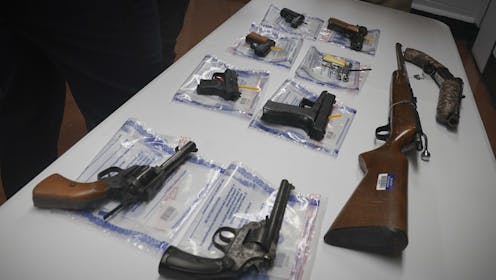
Could calling the illegal use of firearms a “public nuisance” bring an end to the gun industry’s immunity from civil lawsuits?
New York will soon test that notion. State lawmakers recently amended New York’s public nuisance statute[1] to specifically include marketing and sales practices that contribute to gun crimes. Gov. Andrew Cuomo signed the bill[2] on July 6, 2021, after declaring gun violence[3] a “disaster emergency.”
I’ve been researching[4] lawsuits against the gun industry for over 20 years. While I believe New York’s law is certain to unleash a new round of lawsuits against gun-makers, my research suggests that these claims will face considerable legal hurdles[5]. Even if this litigation succeeds – effectively ending the gun industry’s immunity from liability – the jury is still out on whether it will do much to curb gun violence.
Defining illegal gun use as a public nuisance
States routinely rely on public nuisance[6] laws to regulate conduct that unreasonably interferes with the health and safety of others. Common examples[7] include polluting the air or water, obstructing roadways or making excessive noise.
New York’s amended statute holds gun manufacturers and sellers responsible for the public nuisance of illegal gun use if they fail to implement “reasonable controls” to prevent the unlawful sale, possession or use of firearms within the state. The law specifies[8] that “reasonable controls” include implementing programs to secure inventory from theft and prevent illegal retail sales.
Under the law, both public officials and private citizens can file lawsuits seeking money damages and a court injunction to compel offending parties to stop the nuisance. For example, a gun manufacturer who sold weapons that were subsequently used in crimes could be held liable if it failed to take reasonable measures to ensure that retail dealers did not engage in illegal sales practices.
The gun industry’s immunity shield
Suing the firearms industry for gun violence under the theory of public nuisance is nothing new.
Individual gun violence victims, civic organizations such as the NAACP and big-city mayors started filing such lawsuits in the late 1990s[9]. Congress put an end to this litigation in 2005 when it passed the Protection of Lawful Commerce in Arms Act[10], which granted gun sellers – including manufacturers – immunity from liability arising out of criminal misuse of the weapons they sold.
Immunity under the act is not absolute. Notably, a seller is not immune[11] from liability if it “knowingly violated a state or federal statute applicable to the sale or marketing” of firearms. Consequently, following the passage of the act, plaintiffs argued[12] that gun-makers’ marketing, distribution and sales practices constituted a public nuisance in violation of state statutes.
However, federal appellate courts in New York[13] and California[14] rejected this argument. Those courts held that public nuisance laws did not qualify for the exception to immunity because they were not specifically aimed at regulating firearms.
Challenges ahead for New York’s new law
New York responded by updating its statute.
The state is hoping to prompt civil litigation that will bring pressure on the industry to prevent the diversion of guns into the black market and the hands of illegal gun traffickers. Before the federal immunity bill, the industry faced a rising tide[15] of litigation.
New lawsuits, however, will face multiple challenges, which I believe will likely reach all the way to the U.S. Supreme Court. I will consider two prominent ones.
First, gun industry defendants will argue that New York’s amended public nuisance statute is an attempt to subvert the purpose of 2005 law, which was passed specifically to halt these types of claims[16] against gun sellers in the 1990s and early 2000s.
The opening section[17] of the immunity law denounces this litigation as “an abuse of the legal system.” New York’s claim to utilize a narrow exception to gun industry immunity looks an awful lot like an attempt to eliminate immunity altogether.
At the same time, the letter of the law allows claims arising out of the violation of any statute that specifically applies to the sale of firearms, which is exactly what New York’s amended public nuisance law does.
For the Supreme Court, these contending views would pit the conservative majority’s strong allegiance to gun rights[18] against its insistence on sticking to the letter of the law[19] when reading statutes.
Second, gun industry defendants will argue[20] that the Second Amendment[21] limits any type of litigation likely to restrict access to the lawful purchase of firearms.
In a series of landmark cases[22], the Supreme Court said the Second Amendment protects the right of individuals to own firearms “in common use” for “lawful purposes like self-defense.” If public nuisance lawsuits were to drive some gun-makers into bankruptcy, courts might view them as a threat to Second Amendment rights.
However, the Second Amendment is silent on how to balance the constitutional right to keep and bear arms against the right Americans have to sue in civil court. How the Supreme Court might rule on this particular challenge is unclear.
Impact on reducing gun violence
But let’s assume for a moment that nuisance lawsuits survive a Supreme Court challenge, effectively ending the gun industry’s liability shield. Would this litigation then be able to reduce gun violence?
The main impact of these lawsuits is to put pressure on gun manufactures to do more to prevent inventory theft and illegal sales by retailers. Since 2000, the gun industry has operated a program[23] to prevent illegal straw purchases, suggesting manufactures think they may be able to affect how retailers operate. Even still, little is known about whether this program has had any impact on gun violence rates. That’s why no one really knows if forcing gun manufacturers to more closely supervise retailers will work.
Part of the problem is a lack of government funding[24] since the mid-1990s for public health research on alleged links between industry sales practices and gun crimes. Recent funding[25] for this kind of research may clarify the value of regulating illegal gun sales as a public nuisance.
Until then, passing laws to prompt litigation against the gun industry is just a shot in the dark.
[3 media outlets, 1 religion newsletter. Get stories from The Conversation, AP and RNS.[26]]
References
- ^ recently amended New York’s public nuisance statute (legislation.nysenate.gov)
- ^ Gov. Andrew Cuomo signed the bill (www.businessinsider.com)
- ^ declaring gun violence (www.nydailynews.com)
- ^ I’ve been researching (news.gsu.edu)
- ^ these claims will face considerable legal hurdles (www.press.umich.edu)
- ^ public nuisance (legal-dictionary.thefreedictionary.com)
- ^ Common examples (www.law.cornell.edu)
- ^ law specifies (legislation.nysenate.gov)
- ^ such lawsuits in the late 1990s (www.press.umich.edu)
- ^ Protection of Lawful Commerce in Arms Act (www.law.cornell.edu)
- ^ not immune (www.law.cornell.edu)
- ^ plaintiffs argued (casetext.com)
- ^ New York (law.justia.com)
- ^ California (cdn.ca9.uscourts.gov)
- ^ rising tide (readingroom.law.gsu.edu)
- ^ to halt these types of claims (www.law.cornell.edu)
- ^ opening section (www.law.cornell.edu)
- ^ gun rights (www.reuters.com)
- ^ letter of the law (slate.com)
- ^ will argue (www.law.cornell.edu)
- ^ Second Amendment (constitution.congress.gov)
- ^ landmark cases (constitutioncenter.org)
- ^ gun industry has operated a program (www.dontlie.org)
- ^ lack of government funding (www.ncbi.nlm.nih.gov)
- ^ Recent funding (www.apa.org)
- ^ Get stories from The Conversation, AP and RNS. (theconversation.com)