Christian attitudes surrounding abortion have a more nuanced history than current events suggest
- Written by: Luis Josué Salés, Assistant Professor of Religious Studies, Scripps College
Opponents and supporters of legal abortion in the U.S. will be watching when the Supreme Court hears Dobbs v. Jackson Women’s Health Organization[1] during its upcoming term. In this lawsuit, a Mississippi women’s health center has challenged the constitutionality of a 2018 state law banning abortions after the first 15 weeks of pregnancy. In the Supreme Court’s hands, the case has the potential to affect provisions of Roe v. Wade[2], the landmark decision that legalized abortion in the U.S., and further limit women’s access to abortion in many states[3].
Such challenges to abortion in the United States are often fueled by the belief of many Christians[4] that abortion and Christianity are incompatible. For example, the catechism of the Catholic Church[5], an authoritative guide to the beliefs and practices of Roman Catholic Christians, states: “Since the first century the Church has affirmed the moral evil of every procured abortion. This teaching has not changed and remains unchangeable.”
However, this statement tells only one part of the story. It is true that Christian leaders, virtually all male, have largely condemned abortion. Nonetheless, as a scholar of premodern Christianities[6], I am also aware of the messier realities that this statement conceals.
Celebrating women’s celibacy
The earliest Christian writings – the letters of the Apostle Paul[7] – discouraged marriage and reproduction. Later Christian texts supported these teachings. In a second-century text known as the Acts of Paul and Thekla[8], a Christian author in Asia Minor praised Thekla for rejecting her suitors and avoiding marriage in favor of spreading Christian teachings instead.
In the third century, Thekla’s story inspired a Roman noblewoman called Eugenia. According to the Christian text titled the Acts and Martyrdom of Eugenia[9], Eugenia rejected marriage and led a male monastery for a time. Afterward, she discouraged Alexandrian women from having children, but this advice angered their husbands. These men convinced the emperor Gallienus that Eugenia’s teachings about women’s reproductive choice endangered Rome’s military power by reducing the “supply” of future soldiers. Eugenia was executed in 258 A.D.
Even as the Roman Empire became increasingly Christian, women still received praise for avoiding marriage. For example, the bishop Gregorios of Nyssa, an ancient city near Harmandalı, Turkey, wrote the beautiful text Life of Makrina[10] to celebrate his beloved sister and teacher, who died in 379 A.D. In this text, Gregorios admires Makrina for wittily rejecting suitors by claiming that she owed faithfulness to her dead fiancé.
To sum up, while early Christian texts did not exactly encourage women to explore sexual experiences, neither did they encourage marriage, reproduction and family life.
Choices beyond celibacy
Premodern Christian women had options beside celibacy as well, although the state, the church and mediocre medicine limited their reproductive choices.
In 211 A.D., the Roman emperors Septimius Severus and Caracalla made abortion illegal[11]. Tellingly, though, Roman laws surrounding abortion were centrally concerned with the father’s right to an heir, not with women or fetuses in their own right. Later Roman Christian legislators left that largely unchanged[12].
Conversely, Christian bishops sometimes condemned the injustice of laws regulating sex and reproduction. For example, the bishop Gregorios of Nazianzos, who died in 390 A.D., accused legislators of self-serving hypocrisy[13] for being lenient on men and tough on women. Similarly, the bishop of Constantinople, Ioannes Chrysostomos, who died in 407 A.D., blamed men for putting women in difficult situations that led to abortions[14].
Christian leaders often gathered at meetings called “synods” to discuss religious beliefs and practices. Two of the most important synods concerning abortion were held in Ankyra – currently Ankara, Turkey – in 314 A.D. and in Chalkedon – today’s Kadiköy, Turkey – in 451 A.D. Notably, these two synods drastically reduced the penalties for abortion relative to earlier centuries.
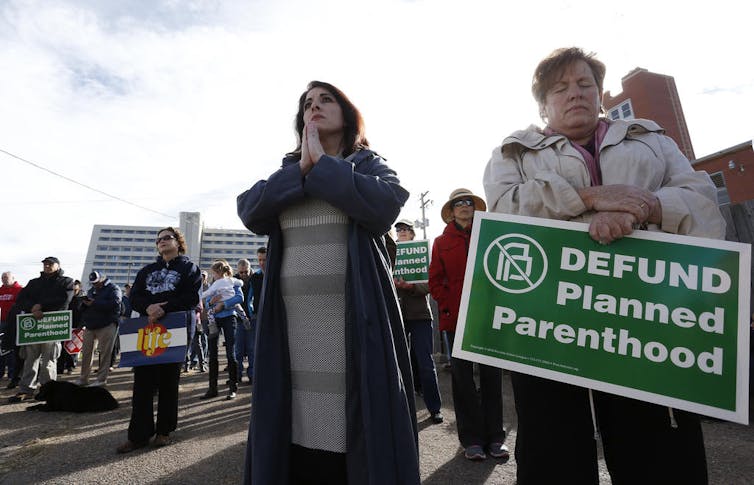 Some contemporary Christians oppose abortion and contraception based on their religious beliefs. But historically the faith has sometimes supported women’s reproductive autonomy.
Brennan Lindsey/AP[15]
Some contemporary Christians oppose abortion and contraception based on their religious beliefs. But historically the faith has sometimes supported women’s reproductive autonomy.
Brennan Lindsey/AP[15]
But over time, these legal and religious opinions did not seem appreciably to affect women’s reproductive choices. Rather, pregnancy prevention and termination methods thrived in premodern Christian societies[16], especially in the medieval Roman Empire. For example, the historian Prokopios of Kaisareia claims that the Roman Empress Theodora nearly perfected contraception and abortion[17] during her time as a sex worker, and yet this charge had no impact on Theodora’s canonization as a saint.
Some evidence even indicates that premodern Christians[18] actively developed reproductive options for women. For instance, Christian physicians, like Aetios of Amida[19] in the sixth century and Paulos of Aigina[20] in the seventh, provided detailed instructions for performing abortions and making contraceptives. Their texts deliberately changed and improved on the medical work of Soranos of Ephesos, who lived in the second century. Many manuscripts contain their work, which indicates these texts circulated openly.
Further Christian texts about holy figures suggest complex Christian perspectives on the acceptable termination of fetal development – and even newborn lives. Consider a sixth-century text, the Egyptian Life of Dorotheos[21]. In this account, the sister of Dorotheos, an Egyptian hermit from Thebes, becomes pregnant while possessed by a demon. But when Dorotheos successfully prays for his sister to miscarry, the text treats the unusual termination of the pregnancy as a miracle, not a moral outrage.
Around 1,100 years later, a similar event happens in the Ethiopian Life of Walatta Petros[22]. According to this text, Walatta Petros, a noblewoman later canonized as a saint, married a general and became pregnant three times. However, every time she conceived, she prayed for her fetus to die promptly if it would “not please God in life.” The narrator tells us that all three of her children died days after birth, since “God heard her prayer.”
Certainly, Christians have a history of opposing methods for preventing and terminating pregnancies. But these premodern texts, spanning some 1,500 years, indicate that Christians also have a history of providing these services, and making them safer for women.
This tense and inconclusive relationship to abortion may be poorly known – or perhaps overlooked for political convenience. But that does not change the fact, as I see it, that Christians who support women’s reproductive rights are also following the historical precedent of their religious tradition.
Religion [3 media outlets, 1 religion newsletter. Get stories from The Conversation, AP and RNS.[23]]
References
- ^ Dobbs v. Jackson Women’s Health Organization (www.scotusblog.com)
- ^ to affect provisions of Roe v. Wade (www.washingtonpost.com)
- ^ many states (www.usnews.com)
- ^ are often fueled by the belief of many Christians (theconversation.com)
- ^ catechism of the Catholic Church (www.vatican.va)
- ^ scholar of premodern Christianities (www.scrippscollege.edu)
- ^ letters of the Apostle Paul (www.biblegateway.com)
- ^ Acts of Paul and Thekla (www.pbs.org)
- ^ Acts and Martyrdom of Eugenia (www.cambridge.org)
- ^ Life of Makrina (sourcebooks.fordham.edu)
- ^ made abortion illegal (www.jstor.org)
- ^ left that largely unchanged (nbls.soc.srcf.net)
- ^ accused legislators of self-serving hypocrisy (www.newadvent.org)
- ^ blamed men for putting women in difficult situations that led to abortions (www.newadvent.org)
- ^ Brennan Lindsey/AP (newsroom.ap.org)
- ^ pregnancy prevention and termination methods thrived in premodern Christian societies (www.scientificamerican.com)
- ^ Theodora nearly perfected contraception and abortion (wps.pearsoncustom.com)
- ^ Some evidence even indicates that premodern Christians (www.medievalists.net)
- ^ Aetios of Amida (medieval.bodleian.ox.ac.uk)
- ^ Paulos of Aigina (library.princeton.edu)
- ^ Egyptian Life of Dorotheos (www.oca.org)
- ^ Life of Walatta Petros (press.princeton.edu)
- ^ Get stories from The Conversation, AP and RNS. (theconversation.com)