Iran Still Affects Australian Trade. Could Trump’s China Visit Lower Fuel Prices
- Written by: The Times
The war involving Iran continues to cast a long shadow across the global economy, with oil markets, shipping routes and business confidence all feeling the pressure.
For Australians, the consequences are not abstract geopolitical theory. Higher fuel prices affect nearly every part of daily life:
- supermarket prices,
- electricity costs,
- freight,
- aviation,
- construction,
- and household budgets.
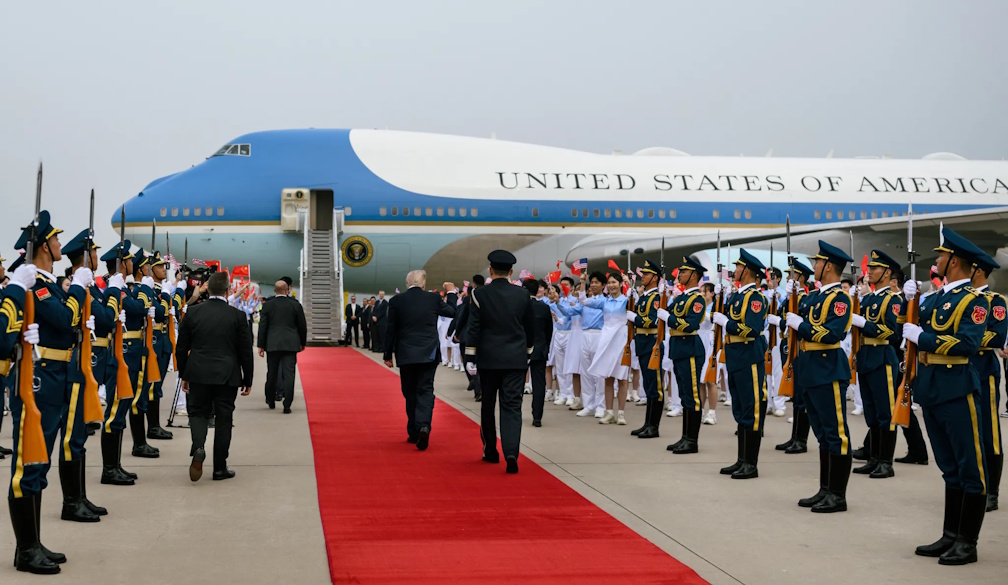
That is why United States President Donald Trump travelling to China this week was about far more than symbolism or diplomacy.
At its core, the visit was also about energy, trade stability and the possibility — however uncertain — of bringing down global fuel prices.
Why Iran Matters So Much To World Trade
Iran occupies one of the world’s most strategically important locations.
The Strait of Hormuz remains a critical maritime corridor through which a large percentage of the world’s oil and liquefied natural gas travels. When instability threatens that route, global markets react almost immediately.
Oil traders fear disruption.
Shipping companies face uncertainty.
Insurance costs rise.
Fuel wholesalers pass on higher prices.
Consumers ultimately pay more.
Recent tensions surrounding Iran and the security of Hormuz have already pushed oil prices sharply higher. Reuters reported Brent crude climbing above US$104 a barrel as ceasefire hopes weakened and conflict fears intensified.
Australia may be geographically distant from the Middle East, but economically it is deeply exposed to global fuel markets.
A rise in oil prices affects:
- trucking companies,
- airlines,
- farmers,
- mining operations,
- delivery services,
- and everyday motorists.
Eventually those increased costs flow into food prices, retail pricing and inflation more broadly.
Treasury modelling reported in Australia warned that a worsening Middle East oil crisis could push inflation dramatically higher and even threaten recessionary conditions.
Why China Is Central To The Equation
China is one of the world’s largest energy consumers and also the biggest buyer of Iranian oil.
That reality gives Beijing influence few nations possess.
American officials reportedly see China as one of the few countries capable of persuading Tehran toward de-escalation or compromise.
This explains why Trump’s visit to Beijing attracted such intense international attention.
The trip was officially framed around trade, tariffs and broader US-China relations, but Iran and oil security sat heavily in the background.
Some analysts believe Washington hopes China can encourage Iran to maintain stability in the Strait of Hormuz and avoid prolonged disruption to global energy flows.
If shipping routes stabilise and oil traders regain confidence, fuel prices could ease substantially.
That is not political fantasy. It is a realistic economic scenario.
Fuel Prices Are Psychological As Well As Physical
Oil markets are heavily influenced by expectations.
If traders believe:
conflict will escalate,
shipping will be interrupted,
or sanctions will intensify,
prices rise quickly.
Conversely, signs of diplomatic progress can reduce panic pricing even before physical oil supply increases.
That is one reason global markets monitored the Trump-Xi meeting so closely.
Even modest diplomatic progress between Washington, Beijing and Tehran could calm markets.
Reuters and multiple financial analysts noted that investors were already placing hopes on China helping reduce tensions surrounding Iran and Hormuz.
In effect, perception itself influences the price Australians pay at the bowser.
Business Leaders Understand What Is At Stake
Trump’s delegation reportedly included major American business figures and corporate leaders.
That alone sends a message.
Large corporations understand that prolonged instability between the United States, China and Iran is damaging for:
- manufacturing,
- freight,
- aviation,
- consumer confidence,
- and investment markets.
Businesses prefer predictable fuel costs and stable trade routes.
So do governments.
The longer oil prices remain elevated, the greater the inflationary pressure across developed economies.
Central banks may respond with higher interest rates.
Borrowers suffer.
Businesses delay investment.
Consumers spend less.
In that sense, Iran is not merely a military or diplomatic issue.
It is a direct economic issue affecting households around the world.
The Australian Perspective
Australia is especially vulnerable because it imports significant quantities of refined fuel and depends heavily on global shipping networks.
A spike in oil prices can affect:
- domestic airfares,
- food freight costs,
- rideshare pricing,
- regional transport,
- and construction materials.
Farmers, miners and logistics operators feel the pressure quickly.
So while Australians may view Trump’s China trip as distant geopolitical theatre, the outcome could eventually influence the price of petrol at local service stations.
That is why world leaders continue pursuing dialogue despite enormous disagreements over Taiwan, trade and strategic competition.
No major economy truly benefits from uncontrolled energy instability.
Symbolism Or Substance?
Critics argue Trump’s China visit produced more ceremony than concrete outcomes.
That criticism may be fair in the short term.
However, diplomacy often works incrementally rather than dramatically.
The mere fact that Washington and Beijing are talking during a period of global instability may itself help steady markets.
Whether China will pressure Iran meaningfully remains uncertain. Analysts remain divided.
But the economic logic is clear:
- lower tensions,
- safer shipping routes,
- more predictable oil flows,
- and calmer markets,
would likely result in lower fuel prices globally.
Including in Australia.
Conclusion
Iran continues to affect world trade in ways extending far beyond the Middle East.
Energy markets, inflation, freight costs and consumer prices are all tied to stability in one of the world’s most critical oil corridors.
That is why Trump’s visit to China mattered.
Not simply because of politics or headlines, but because China may be one of the few global powers capable of influencing Iran’s calculations and helping stabilise energy markets.
If tensions ease and confidence returns to oil markets, Australians could eventually see relief at the petrol pump.
For households and businesses already struggling with inflation and high living costs, that outcome would be more than diplomatic symbolism. It would be economic relief.