Scaling From Café to Retail: How Specialty Brands Control Coffee Pod Quality and Packaging Economics
- Written by: Times Media
The Economics of Specialty Coffee Retail: Why Packaging Is the New Battleground
Overcoming the Revenue Ceiling of Traditional Café Operations
For specialty coffee roasters, physical brick-and-mortar cafés serve as the ultimate brand showcase. However, relying purely on foot traffic presents severe scaling limitations.
Operating physical storefronts subjects businesses to unforgiving commercial reality:
- Escalating Overhead: Fixed costs such as prime retail rent and utility bills continue to rise steadily across metropolitan markets.
- Labor Bottlenecks: Increasing hourly barista wages combined with high employee turnover constrain peak-hour throughput.
- Maintenance Drag: Continuous wear on commercial espresso machinery demands ongoing, non-negotiable capital expenditures.
Transitioning to packaged consumer goods—specifically whole bean, roasted ground, and single-serve pods—fundamentally alters brand unit economics.
DTC (direct-to-consumer) and wholesale retail channels unlock high-margin, recurring revenue streams. They break the physical throughput barrier, allowing roasters to monetize their brand far beyond peak morning hours.
The Shelf-Life Paradox: Freshness vs. Commercial Distribution
In a café environment, espresso is extracted within weeks—sometimes days—of roasting. Once ground, coffee cell structures expose massive surface areas to atmospheric oxygen, accelerating chemical degradation.
Key volatile aromatics dissipate within minutes of grinding. Concurrently, lipid oxidation creates rancid off-flavors, while exposed compounds absorb ambient moisture.
Expanding into regional supermarkets or international e-commerce channels requires extended distribution timelines. Specialty brands face an operational dilemma:
How can you scale into multi-month supply chains without delivering stale products that destroy hard-earned brand equity? The solution lies in engineering modern packaging environments.
Engineering Flavor Preservation: The Role of Nitrogen Flushing in Pod Manufacturing
Why Conventional Vacuum Sealing Fails Ground Coffee
Standard vacuum sealing is a common preservation strategy across food industries, yet it proves inherently flawed when applied to freshly ground roasted coffee.
During thermal roasting, organic molecules undergo pyrolysis, creating high volumes of trapped carbon dioxide within the bean matrix.
Post-roast off-gassing continues for days:
- Deformation: Vacuum sealing sealed pods traps continuous carbon dioxide release, expanding the flexible foil lid and causing physical swelling or seal rupture.
- Structural Failure: Alternatively, degassing coffee prior to packing allows volatile aromatics to escape before sealing ever occurs.
- Trapped Micro-Pockets: Vacuum extraction fails to remove microscopic oxygen pockets trapped within fine espresso grinds.
To preserve the delicate aroma and lipid profiles of specialty grinds over retail distribution cycles, manufacturers must actively displace oxygen prior to sealing.
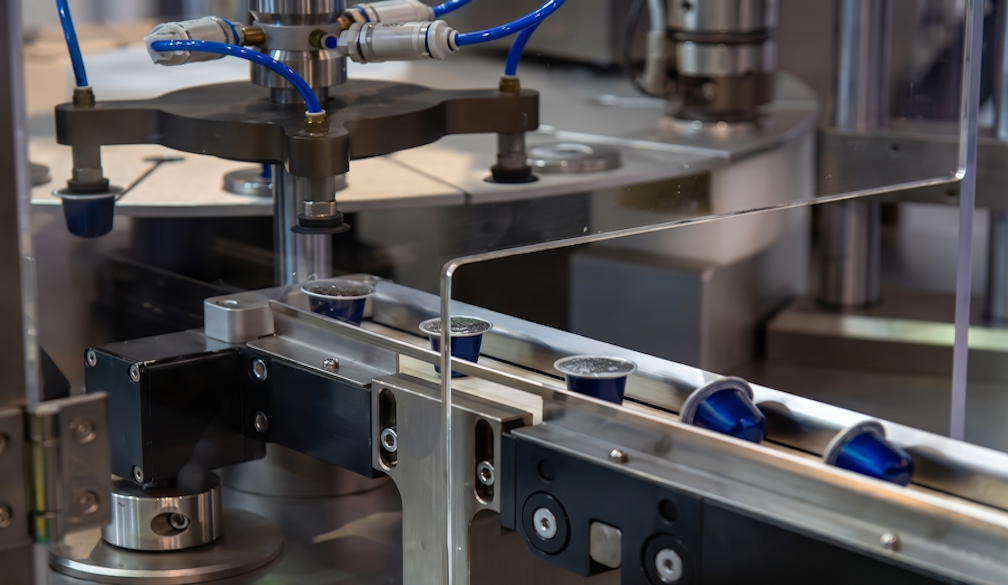
Modern packaging lines utilize high-precision automated gas injection; in fact, benchmark data from commercial coffee capsule filling machines manufactured by SANEU indicates that achieving up to 99.9% nitrogen purity levels within the capsule cavity reduces residual oxygen below 2%, successfully extending ambient shelf life beyond 12 months while locking in volatile flavor compounds.
Setting the Quality Benchmark: Achieving >99% Nitrogen Purity
The mechanical execution of nitrogen flushing relies on inert gas displacement during the high-speed dosing phase.
Automated filling systems flood the open capsule chamber and the internal dosing funnel with food-grade nitrogen gas.
By surrounding ground coffee with inert nitrogen during the exact millisecond of top-foil application, oxygen is displaced from the interstitial spaces between coffee grounds.
Capsule Packaging Integrity: Safety Standards and Eco-Friendly Materials
Eliminating Toxins: Avoiding BPA and Material Migration in High-Temp Brewing
Single-serve pod extraction exposes materials to extreme physical stress. Commercial single-serve brewers inject water at temperatures between 90°C and 96°C under hydraulic pressures reaching up to 19 bar.
Under these thermal conditions, low-grade plastic containers present severe chemical migration risks:
- Endocrine Disruption: Poorly manufactured polypropylenes leach harmful Bisphenol-A (BPA) or plasticizers into the brewed liquid.
- Flavor Contamination: Thermal degradation imparts distinct synthetic or metallic residual flavors to delicate light roasts.
To maintain compliance and quality, specialty roasters utilize advanced food-grade barrier structures:
-
Multi-Layer EVOH Plastics: Ethylene Vinyl Alcohol layers sandwiched between virgin polypropylene prevent oxygen transmission while maintaining structural integrity under heat.
-
Mono-Material Aluminum Capsules: Provides an absolute barrier against light, oxygen, and moisture without requiring chemical softeners.
Balancing Biodegradability with Oxygen Barrier Functionality
As sustainable consumption moves from consumer preference to mandatory policy, roasters are evaluating compostable polymers like Polylactic Acid (PLA) and Polyhydroxyalkanoates (PHA).
Biodegradable materials naturally exhibit higher Oxygen Transmission Rates (OTR). Without secondary flow-wrap packaging, compostable capsules often compromise delicate acid profiles over extended distribution cycles.
Key Takeaways
|
Area |
Key Takeaway |
Impact/Data |
|
Strategy |
Shift from café service to retail pod distribution |
Unlocks high-margin, recurring revenue beyond store foot-traffic limits |
|
Freshness |
Flush capsules with high-purity (>99%) nitrogen gas |
Reduces residual O2 below 2%; extends shelf life >12 months |
|
Safety |
Use multi-layer EVOH or mono-aluminum packaging |
Prevents BPA leaching and off-flavors at 90–96°C, 19-bar extraction |
|
Production |
Build in-house packaging lines instead of co-packing |
Eliminates 50k+ unit MOQs, schedule delays, and lost quality control |
|
Margins |
Calibrate servo-driven augers to ±0.15g accuracy |
Prevents 300kg coffee waste per 1M pods (+0.30g variance) |
CapEx vs. Quality: Structuring Your Packaging Line for Scale
In-House Automated Sealing vs. Third-Party Co-Packing
Scaling pod production forces founders to choose between investing in proprietary packaging lines or outsourcing to third-party co-packers.
Outsourcing to Co-Packers reduces initial capital investment. However, it imposes notable operational limitations:
- High Minimum Order Quantities (MOQs): Co-packers often require production runs exceeding 50,000 units per origin, straining cash flow for micro-lot coffees.
- Schedule Bottlenecks: Production queues can delay seasonal product launches by weeks or months.
- Loss of Quality Control: Roasters yield control over nitrogen purge consistency, grind distribution, and immediate post-roast packaging timing.
In-House Packaging Machinery requires initial capital expenditure, but delivers operational advantages:
- Immediate Processing: Coffee is ground, purged, and sealed within optimal post-roast degassing windows.
- Micro-Batch Agility: Roasters can package limited single-origin releases in runs as small as 1,000 units without penalty.
- Process Transparency: Direct monitoring of nitrogen purity levels, seal integrity, and dose weights.
Precision Gram-Weight Accuracy and Margin Protection
At commercial scale, minor dosing variances aggregate into major financial impacts. Single-serve pods typically hold between 5.0g and 10.0g of ground coffee.
Operating uncalibrated volumetric auger fillers creates severe financial and sensory risk:
- Under-Dosing: Creates fast water channeling, resulting in sour, under-extracted, watery espresso.
- Over-Dosing: Chokes the extraction pump, yielding bitter, over-extracted coffee while destroying unit profitability.
Consider a roaster producing 1,000,000 pods annually using green coffee costing $12.00/kg:
An uncontrolled positive variance averaging just +0.30g per pod results in 300 kg of wasted roast coffee annually—representing thousands of dollars in lost margin.
High-precision servo-driven auger systems maintain dosing tolerances within 0.15g, protecting both extract yield and commercial margins.
As specialty brands transition from plastic pods to aluminum or compostable barrier materials, regulatory compliance regarding material migration during high-temperature brewing is paramount.
Manufacturers must continually adapt to stringent international frameworks, such as the evolving EU packaging and packaging waste regulations, which dictate strict recycling thresholds, material safety certifications, and supply chain accountability across the beverage industry.
Maintaining control over dosing accuracy, nitrogen purity, and barrier material selection allows specialty coffee roasters to bridge the gap between artisanal café quality and profitable retail scale.