The Evolving Economic Pressures on Modern Food Supply Chains
- Written by: Times Media
Global food distribution networks operate under tightening financial margins, driven by rising diesel prices, escalating maritime shipping rates, and increased warehouse storage overhead. Traditional packaging formats, specifically heavy glass jars and three-piece tinplate cans, introduce significant physical inefficiencies that compound these logistical costs. Glass containers present severe shatter vulnerabilities during transit and automated filling, leading to direct product loss and hazardous line stoppages.
Metal cans, while robust, are susceptible to external denting and internal seam corrosion when exposed to acidic or high-sodium food matrices over extended periods. Furthermore, the complete opacity of metal tinplate removes visual product verification, creating friction in modern retail merchandising where consumer transparency directly dictates purchasing behavior.
When evaluating strategies to streamline supply chain logistics and minimize transit weight, commercial food processors increasingly turn to alternative polymer solutions. According to technical industry standards observed in modern outstandingpack, high-precision food-grade PET containers paired with advanced automated sealing systems can achieve identical hermetic integrity to traditional rigid containers while significantly reducing tare weight and cutting long-haul freight inefficiencies. This structural transition enables manufacturers to stabilize unit economics without compromising the mechanical protection required for global distribution.
Modern enterprise operations require packaging strategies that align with aggressive efficiency targets. By restructuring packaging formats away from high-density materials, brand owners can optimize modern supply chain management strategies to buffer against unpredictable macroeconomic shocks.
Quantifying the Impact of Material Weight on Long-Haul Freight Efficiency
The physical weight of packaging material directly dictates the volumetric efficiency and fuel consumption of intermodal freight distribution. Replacing a standard 350-gram glass jar with a structurally equivalent 40-gram Polyethylene Terephthalate (PET) container yields an immediate tare weight reduction exceeding 88%. This exponential decrease in container deadweight transforms pallet-level freight economics.
In long-haul distribution, gross vehicle weight restrictions often limit payload capacity long before cargo volume is fully maximized. Lowering container tare weight allows logistics coordinators to pack more sellable product units onto each pallet, thereby increasing product yield per container load and reducing per-unit transport costs.
- Pallet Yield Maximization: Lighter containers allow additional tiers of product per pallet within standard legal highway weight limits, reducing total shipments required to fulfill regional inventory demand.
- Fuel Consumption Reduction: Decreased trailing weight directly lowers diesel fuel burn during over-the-road transport, generating measurable operational expenditure savings.
- Carbon Footprint Mitigation: Optimizing payload efficiency reduces Scope 3 greenhouse gas emissions per delivered unit, aligning commercial operations with corporate sustainability mandates.
Material Science Innovations: Why Food-Grade PET Outperforms Traditional Containers
Food-grade Polyethylene Terephthalate (PET) represents a material engineering breakthrough that balances structural rigidity with extreme lightweighting. Unlike conventional industrial plastics, biaxially oriented PET features a highly aligned molecular polymer chain that delivers superior tensile strength and optical clarity comparable to glass.
This engineered polymer framework exhibits high elastic modulus and remarkable impact resistance, effectively eliminating the shatter risk that plagues glass manufacturing lines. Furthermore, advanced blow-molding techniques ensure uniform sidewall thickness, preventing container deformation during vacuum sealing and high-speed mechanical labeling.
|
Packaging Material |
Tare Weight Impact |
Oxygen Barrier Performance |
Impact Resistance |
Freight Cost Efficiency |
|
Food-Grade PET |
Extremely Low (~40g equivalent) |
High (Engineered OTR Optimization) |
Shatterproof (High elastic recovery) |
Optimal (Maximized pallet yield) |
|
Standard Glass |
Extremely High (~350g equivalent) |
Absolute Barrier |
Fragile (High shatter vulnerability) |
Poor (High deadweight overhead) |
|
Tinplate Metal |
Moderate (~80g equivalent) |
Absolute Barrier |
Rigid (Susceptible to denting) |
Moderate (Standard volumetric yield) |
Controlling Oxygen and Moisture Barrier Integrity for Extended Shelf Life
Preserving sensory profiles, nutritional value, and shelf stability in commercial food processing depends entirely on controlling atmospheric exchange across the packaging boundary. Oxygen ingress and water vapor transmission serve as primary catalysts for lipid oxidation, microbial proliferation, and textural degradation in sensitive food matrices.
Virgin food-grade PET exhibits a dense crystalline structure that intrinsically restricts moisture permeability, effectively preventing atmospheric humidity from degrading dry goods, confectionery, nuts, and dehydrated powders. To manage the Oxygen Transmission Rate (OTR) for oxidation-sensitive formulations, polymer engineers implement specialized passive barrier coatings and active oxygen scavenging technologies directly into the container resin.
- Water Vapor Transmission Rate (WVTR) Control: Retains internal moisture for liquid and semi-liquid condiments while shielding hygroscopic powders from external atmospheric humidity.
- Precision OTR Management: Prevents oxidative rancidity in lipid-dense foods like roasted nuts and specialty sauces, extending commercial shelf life without chemical preservatives.
- UV Light Protection: Specialized amber and opaque PET masterbatch additives block UV wavelength transmission, safeguarding light-sensitive vitamins and organic pigments from photo-degradation.
Engineering High-Speed Automated Sealing Lines for Maximum Output
Integrating rigid PET containers into automated processing plants requires precise mechanical synchronization between rotary filling equipment and downstream sealing systems. Unlike metal cans, which withstand aggressive axial loads, polymer containers require specialized seaming mechanics to achieve a hermetic seal without structural buckling.
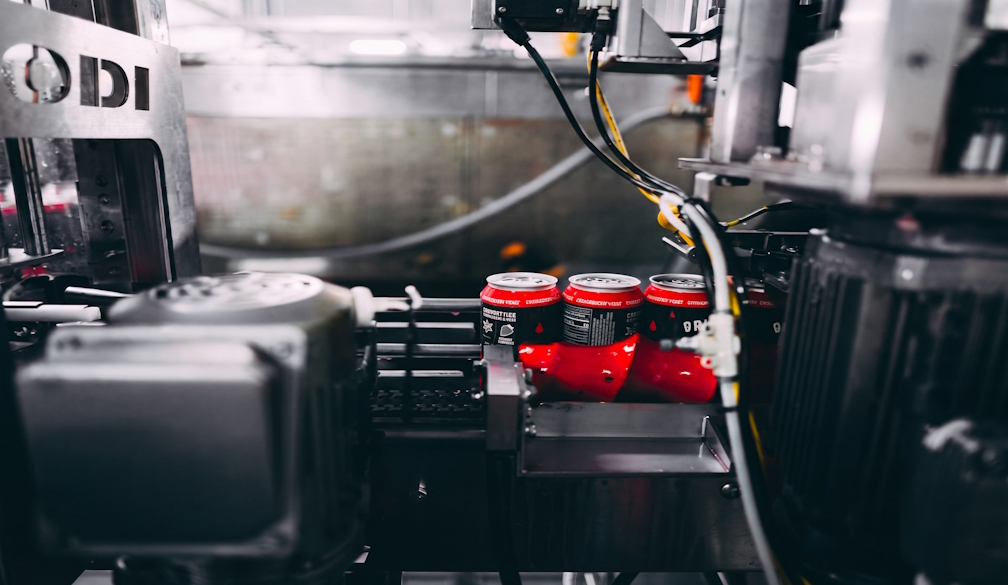
Modern automated seaming machines utilize synchronized rotary configurations capable of processing from 150 to over 600 Cans Per Minute (CPM). Achieving zero-leakage seals at these velocities relies on managing the double-seaming process, where an aluminum Easy-Open End (EOE) is mechanically interlocked with the polymer container flange.
- Chuck Pressure Regulation: Downward top-load pressure must be calibrated to engage the aluminum lid firmly without exceeding the vertical compressive strength of the PET sidewalls.
- Seaming Roll Profiles: First-operation rollers gently curl the aluminum lid flange under the polymer container lip, while second-operation rollers flatten and compress the elastomeric sealing compound to guarantee an airtight bond.
- Inline Optical Inspection: High-speed machine vision systems monitor seam thickness and countersink depth in real-time, instantly rejecting out-of-tolerance units before downstream palletization.
Automated line integration minimizes human intervention, drastically reducing biological contamination risks and mechanical packaging waste. Upgrading to modular seaming infrastructure directly supports advanced manufacturing technology trends by enhancing Overall Equipment Effectiveness (OEE) across the factory floor.
Regulatory Compliance and Sustainability Standards in Global Packaging
Deploying polymer packaging across international markets requires strict adherence to global food contact safety regulations and environmental sustainability mandates. Food processing facilities must verify that all container resins, masterbatch colorants, and lid sealing compounds remain chemically inert across diverse thermal processing and storage conditions.
Beyond logistics efficiency and shelf-life extension, regulatory compliance remains a paramount priority for food brands navigating international markets. All polymers and sealing components utilized in commercial production must strictly satisfy chemical migration limits and material safety criteria. As outlined in the official regulatory frameworks for food contact substances, materials intended for direct food contact must undergo rigorous extraction and thermal testing to ensure they do not alter product composition or compromise consumer safety.
Simultaneously, commercial brand owners face escalating pressure from regulatory bodies and retail partners to integrate circular economy principles into their packaging infrastructure. Single-stream recyclability has become a mandatory commercial requirement across North American, European, and Australasian jurisdictions.
PET stands as the most widely recycled polymer globally, featuring established municipal reclamation networks that convert post-consumer containers into high-grade rPET resin. Designing packaging formats that utilize standard PET bodies paired with easily separable aluminum ends ensures compatibility with automated Material Recovery Facilities (MRFs), advancing enterprise environmental, social, and governance (ESG) targets.
Key Takeaways
|
Area |
Key Takeaway |
Impact/Data |
|
Freight |
Replace heavy glass jars with PET |
Tare weight cut by >88% |
|
Throughput |
Deploy synchronized rotary seaming machines |
Speeds exceed 600 CPM |
|
Shelf Life |
Integrate active OTR/WVTR barrier resins |
Prevents oxidation without preservatives |
|
Quality Control |
Implement inline optical seam inspection |
Achieves zero-leakage seals |
|
Sustainability |
Adopt single-stream recyclable PET formats |
Lowers Scope 3 emissions |
Conclusion: Strategic Packaging Choices for Resilient Commercial Operations
Modernizing commercial food processing infrastructure requires moving beyond traditional packaging materials in favor of engineered polymer systems. The integration of precision-molded PET containers with high-speed automated seaming lines eliminates historical trade-offs between packaging durability, shelf-life preservation, and freight efficiency. By significantly reducing container tare weight, minimizing line breakage, and safeguarding product integrity through advanced barrier science, food manufacturers establish a highly scalable operating model. Strategic investment in lightweight polymer packaging directly enhances supply chain resilience, lowers total cost of ownership, and positions commercial food brands for sustainable, profitable growth in competitive global markets.